
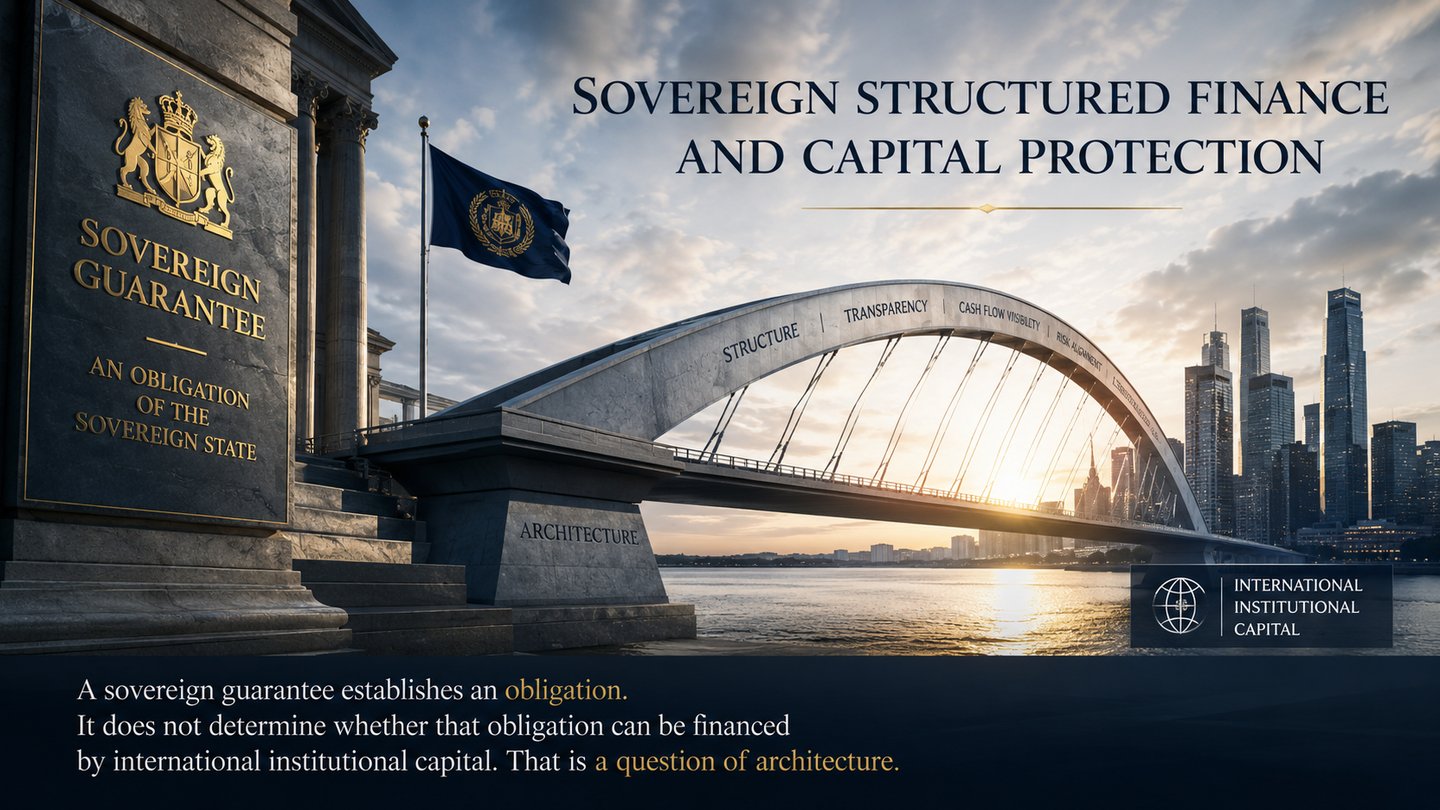
Sovereign Structured Finance and Capital Protection
A sovereign guarantee establishes an obligation. It does not determine whether that obligation can be financed by international institutional capital. That is a question of architecture.
Beyond conventional sovereign lending
Ministries of finance approach international markets with a model formed in the official sector: the State stands behind the obligation, therefore a lender should be found. In bilateral, multilateral and development finance that reasoning carries. In private capital markets it carries considerably less far.
A sovereign guarantee does not remove sovereign credit exposure. It repackages it. The guarantor and the ultimate economic obligor belong to the same credit complex, and institutional investors price them as such. There is no credit transformation in a promise supported by a second promise from the same source.
The operative question in the institutional market is therefore not whether a State is willing to guarantee. It is whether the financing has been constructed so that risk is allocated deliberately, investor principal is protected in economic substance, and the resulting instrument satisfies an actual investment mandate.
International Finance Bank begins from that question.
From sovereign borrowing to investable issuance
A funding requirement is not a product. Before any instrument is proposed, the Bank examines what the sovereign is financing, over what horizon, from which revenues, under which law and against which existing obligations.
Where the analysis supports it, the requirement may be developed into a capital-markets issuance or programme with defined payment obligations, stated maturities, explicit risk allocation and, where appropriate, credit enhancement or capital-protection features.
The purpose is not financial engineering. It is to reconcile two requirements that ordinarily pull against each other: the sovereign’s need for substantial, long-dated, deployable capital, and the institutional investor’s need for risk that is defined, priced and mitigated.
Conventional issuance remains the right answer in many cases. Where it is, the Bank says so.
Capital protection is a structuring principle, not a label
The phrase is used loosely in the market. It should not be.
Protection can mean a further contractual promise by the same sovereign, which changes little. It can mean identified assets or cash flows that economically support repayment of principal. It can mean segregated and funded reserves. It can mean defined risk assumed by an independent, highly rated third party. These are not variations of one idea. They sit at materially different points on the credit spectrum, and only some of them alter what an investor is actually exposed to.
IFB examines whether a proposed transaction can incorporate mechanisms that reduce an investor’s dependence on the sovereign’s future fiscal capacity alone. Whether that is achievable depends on the jurisdiction, the insolvency and immunity position, the enforceability of security, currency and transfer risk, the quality of the supporting assets and the documentation.
The Bank does not publish its structuring methodology, protection models, tranche construction or payment architecture. Those are developed transaction by transaction, confidentially, with the competent authorities and their advisers.
The trade-off, stated plainly
Capital protection has a price, and somebody pays it.
Where protection is funded from the transaction itself, less capital is immediately deployable. Where it is supplied externally, by a multilateral institution, a development finance institution, an export credit agency, a rated guarantor, an insurer, a reserve fund, a collateral pool or dedicated project revenues, the sovereign retains more proceeds and pays for the enhancement in another form.
There is no arrangement in which protection is free. Any proposal suggesting otherwise deserves scepticism, including ours.
What structuring can do is make the trade-off visible and let the sovereign choose its position on it rather than accept the single point a bilateral lender happens to offer.
Access to a wider investor base
A properly constructed sovereign transaction can reach capital that a bilateral loan cannot.
Depending on the structure and market conditions, the eligible universe may include banks, institutional asset managers, pension and insurance capital, sovereign and strategic investors, specialised credit funds and other professional counterparties. Certain of these investors actively require long-duration assets, which is precisely what sovereigns most often need and commercial lenders are least willing to provide.
Diversification follows. So does repeatability. A first transaction executed properly is not only financing. It establishes documentation, precedent, investor relationships and a reference point for the next one. That is worth more than the proceeds of any single issue.
Restraint in structuring
Sophistication does not increase marketability. Frequently it reduces it.
Innovative sovereign instruments have repeatedly attracted institutional interest in principle and limited uptake in practice, for reasons that have less to do with the economics than with complexity, inconsistent data and the absence of standardisation. Investors decline what they cannot model.
The objective is the greatest credit enhancement achievable with the least structural complexity. An investment committee should be able to follow the payment priority on a single page. If it cannot, the structure has a marketing problem regardless of its merits.
How the Bank works
Diagnostic. Debt sustainability and existing indebtedness, rating position, reserves, revenue streams, available assets, outstanding guarantees, programme conditionality and debt ceilings, governing law, immunity and collateral capacity, and the intended use of proceeds.
Structure design. Alternatives are developed and compared on the terms that matter to a finance ministry: net proceeds, cost, tenor, coverage, protection, expected market reception and the investor universe each option opens. Conventional issuance is always one of the alternatives tested, not a straw man.
Execution. Documentation, arrangers and placement, trustee, paying agent and custodian arrangements, listing and clearing where appropriate, investor engagement, bookbuilding, allocation and settlement.
Institutional discipline
Structured finance does not make sovereign debt disappear.
IFB does not participate in structures whose principal purpose is to obscure public indebtedness, evade fiscal controls or borrowing limits, or misrepresent the economic substance of a sovereign obligation. Opaque guaranteed, collateralised and securitised financing has damaged sovereigns before, and the institutions that examine such arrangements have become considerably less patient with them. A structure that cannot be shown to a central bank, an auditor and a rating agency is not one the Bank will build.
Every transaction remains subject to applicable legal, regulatory, compliance, sanctions, credit, market and risk requirements. Where capital protection or credit enhancement is contemplated, its effectiveness depends on the specific counterparties, assets, documentation and market conditions. No representation as to protection, rating outcome, placement capacity or funding cost is made before a transaction has been assessed.
The questions we answer first
Before any discussion of instruments, the Bank addresses what governments actually need to know:
- How much of the requirement is realistically raisable, and on what timetable
- What it costs, all-in, and over what tenor
- What the State is asked to pledge, and what it is not
- How the transaction is treated for debt reporting and against existing programme conditionality
- What parliamentary or constitutional authorisation is required
- How rating agencies are likely to view the structure
- What happens, mechanically, if the State cannot pay
Answers to those questions determine whether a structure is worth designing. The architecture comes afterwards.
Sovereign capital solutions
The Bank’s role is not to decide whether capital can be provided. It is to establish how a sovereign funding requirement can be turned into a structure that international institutional capital can credibly hold.
For governments seeking financing at scale, that distinction decides the outcome.
International Finance Bank works with sovereigns and duly authorised public-sector institutions to develop financing structures appropriate to the requirements of international institutional capital. Initial discussions are conducted confidentially and without obligation.