

National Development Capital Facility
National Development Capital Facility
Financing productive national assets through disciplined sovereign capital structuring
A country’s capacity to develop infrastructure and industry depends on more than the nominal availability of capital. It depends on whether a project can be prepared, authorised, financed and operated under obligations the State can sustain.
The mismatch is familiar. Infrastructure requires capital for fifteen or twenty years, while available bank finance may mature much sooner. A project may earn revenue in local currency while its imported equipment and external debt are denominated in dollars or euros. Domestic pension and insurance funds may hold substantial long-term savings but lack instruments whose governance, liquidity and risk characteristics satisfy their mandates.
International investors, meanwhile, may see a sovereign rating without being able to distinguish the risks of a particular asset from the risks of the State as a whole.
International Finance Bank LTD’s National Development Capital Facility is a mandate to address these questions in their proper order. IFB works with duly authorised sovereign and public-sector clients to assess a defined project or portfolio, design an appropriate financing architecture, examine potential risk-sharing arrangements and test whether domestic and international institutional capital can be mobilised on acceptable terms.
The Facility is not a pre-approved line of credit, a standing pool of investor money or a promise of a particular interest rate. Its deliverable is an evidence-based route to a financing decision. In some cases, that route will lead to a capital-markets instrument or project-finance transaction. In others, ordinary sovereign borrowing, concessional finance, direct budget funding or postponement will be the sounder conclusion.
The mandate starts with the national balance sheet
A proposed financing must be assessed alongside the State’s existing obligations. IFB’s initial work therefore examines the government’s debt profile, refinancing concentrations, currency composition, debt-service capacity, outstanding guarantees and obligations of relevant public enterprises. It considers the treatment of the proposed transaction under domestic law, fiscal reporting rules and any applicable debt ceilings or financing programmes.
This matters even when a project is established as a separate legal entity. A special-purpose company may clarify ownership and segregate project accounts, but it does not, by its existence, remove the economic effect of a sovereign guarantee, an availability payment, a minimum-revenue undertaking or an expectation that the State will rescue an essential public service. Direct and contingent commitments must be identified, valued where practicable, approved and reported under the applicable framework. World Bank guidance specifically calls for governments to assess, budget, monitor and disclose fiscal commitments arising from public-private partnerships.
For countries using an IMF–World Bank debt sustainability analysis, the proposed obligations and plausible shocks must also be considered against that analysis. The framework examines baseline debt dynamics and risks including contingent liabilities, commodity prices, natural disasters and market-financing shocks.
The central question is not whether a transaction can be placed outside a particular accounting line. It is whether the State can bear its actual obligations under credible conditions, including adverse ones.
What may enter the Facility
The Facility is intended for projects or portfolios with a clearly established public purpose and a definable financing requirement. Potential sectors include electricity generation and transmission, water systems, ports and logistics, productive agriculture, industrial processing and other infrastructure that supports domestic value creation.
Projects can have different payment models. Their differences must be preserved:
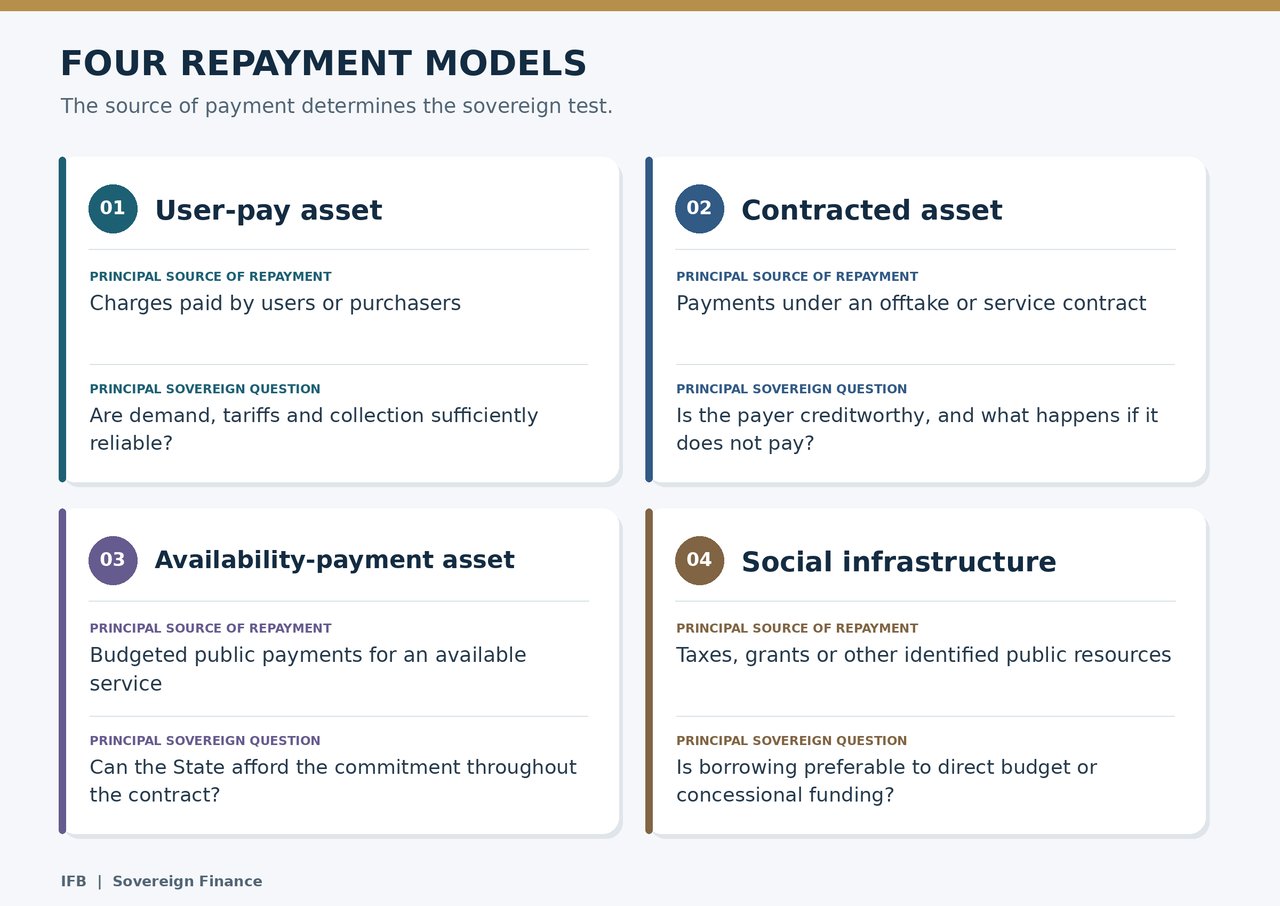
A school or hospital may deliver exceptional economic and social value without generating project revenue. IFB would not present its social return as though it were cash available for debt service. Such assets require an explicit, affordable public payment source or another suitable form of funding.
Project preparation must also address land and permits, procurement, environmental and social obligations, engineering, construction timetable, operating capacity, maintenance and eventual asset handover. The IMF’s public investment assessment framework places project appraisal, selection, budgeting and implementation within the wider quality of public investment management; its climate module adds assessment of physical climate risks and resilience.
A financing structure built around the asset
Once a project passes the initial public and fiscal tests, IFB examines the capital structure. Depending on the transaction, this may combine sponsor equity, public capital contributions, concessional or development-finance participation, commercial debt, institutional notes and a defined reserve. No layer is included merely to make the structure appear more sophisticated.
The design follows five principles.
First, the maturity of funding should reflect the life of the asset. A long-lived power or transport asset should not depend on repeated short-term refinancing without an explicit and affordable refinancing plan.
Second, currency risk must have an identifiable bearer. Local-currency revenue does not service foreign-currency debt at a fixed economic cost. A transaction may use domestic-currency funding, appropriately priced hedging, contractual indexation or a combination. Each choice has fiscal and commercial consequences.
Third, each risk should be assigned to a party able to manage or price it. Construction completion, operating performance, demand, offtaker payment, political action and currency transfer are different exposures. A sovereign guarantee covering all of them may be simple to write but costly for the State and ineffective at improving discipline.
Fourth, credit enhancement must demonstrably improve the transaction. A funded reserve, independent guarantee, development-finance risk participation, insurance policy or pledged cash flow has a cost. IFB assesses whether the resulting reduction in financing cost or improvement in tenor justifies that cost. A further promise by the same sovereign cannot, on its own, transform the underlying sovereign credit risk. IFB already states this distinction on its sovereign structured finance page.
Fifth, the payment order must be intelligible. Investors and the sovereign should be able to identify where revenues enter, who controls the accounts, which operating costs are paid first, when debt service and reserves are funded, and when distributions are permitted. Complexity that cannot be explained and audited is a liability.
Mobilising domestic capital responsibly
Domestic pension funds, insurers, banks and sovereign investment institutions can be valuable providers of long-duration capital. Their participation can also reduce a project’s dependence on foreign currency. It should never be presumed simply because those institutions hold assets.
IFB would assess each investor’s mandate, concentration limits, liquidity needs, permitted instruments and governance requirements. A domestic institution should invest on terms that satisfy its duties to its own beneficiaries. A government instruction to absorb unsuitable project risk is not capital mobilisation; it transfers fiscal risk to savers.
A domestic tranche may differ from an international tranche in currency, tenor or payment profile. Any difference must be economically justified and disclosed. Where development-finance participation or an independent guarantee is available, the aim is to use it to bring in otherwise unavailable private capital, rather than displace investors willing to participate without support. World Bank infrastructure-finance guidance describes the distinct roles of public, multilateral and private capital, and the contractual protections investors typically require.
Sovereign control and public accountability
The sovereign retains control of policy, public approvals, procurement decisions and the decision whether to incur debt or provide support. IFB’s task is to present the options and their consequences clearly.
Before a transaction advances, the responsible authority should be able to identify:
- The legal entity that borrows and the authority under which it acts.
- Every direct State payment, guarantee and contingent obligation.
- The expected use of proceeds and controls over disbursement.
- The ownership and control of project assets and revenue accounts.
- The rules for procurement, related-party transactions and conflicts of interest.
- The accounting and public-debt treatment proposed by competent advisers.
- The circumstances in which lenders can accelerate, enforce security or seek State payment.
- The implications of restructuring, termination or project failure.
Confidential negotiations may protect legitimate commercial information. They do not remove the need for lawful authorisation, fiscal disclosure and independent scrutiny. IFB would develop the transaction with the client’s legal, fiscal and technical advisers and, where relevant, its multilateral partners.
The stress test precedes investor marketing
A base-case financial model is insufficient. Before a financing is presented as viable, the parties must examine how it performs under adverse but plausible conditions. Depending on the asset, these may include delayed completion, higher construction cost, lower demand, weaker collections, an offtaker default, exchange-rate depreciation, higher refinancing rates, commodity-price movements or a climate event.
The assessment must show who pays, when, and from which source in each case. If the answer becomes an unbudgeted Treasury payment, that exposure must be made visible. If the project cannot survive a plausible shock without commitments the State cannot afford, its financing or scope must change.
IFB would distinguish three conclusions: the project is financeable on the proposed terms; it may become financeable after defined changes; or it should not proceed through this Facility. A decision to decline a weak structure protects sovereign capacity for stronger projects.
How an engagement proceeds
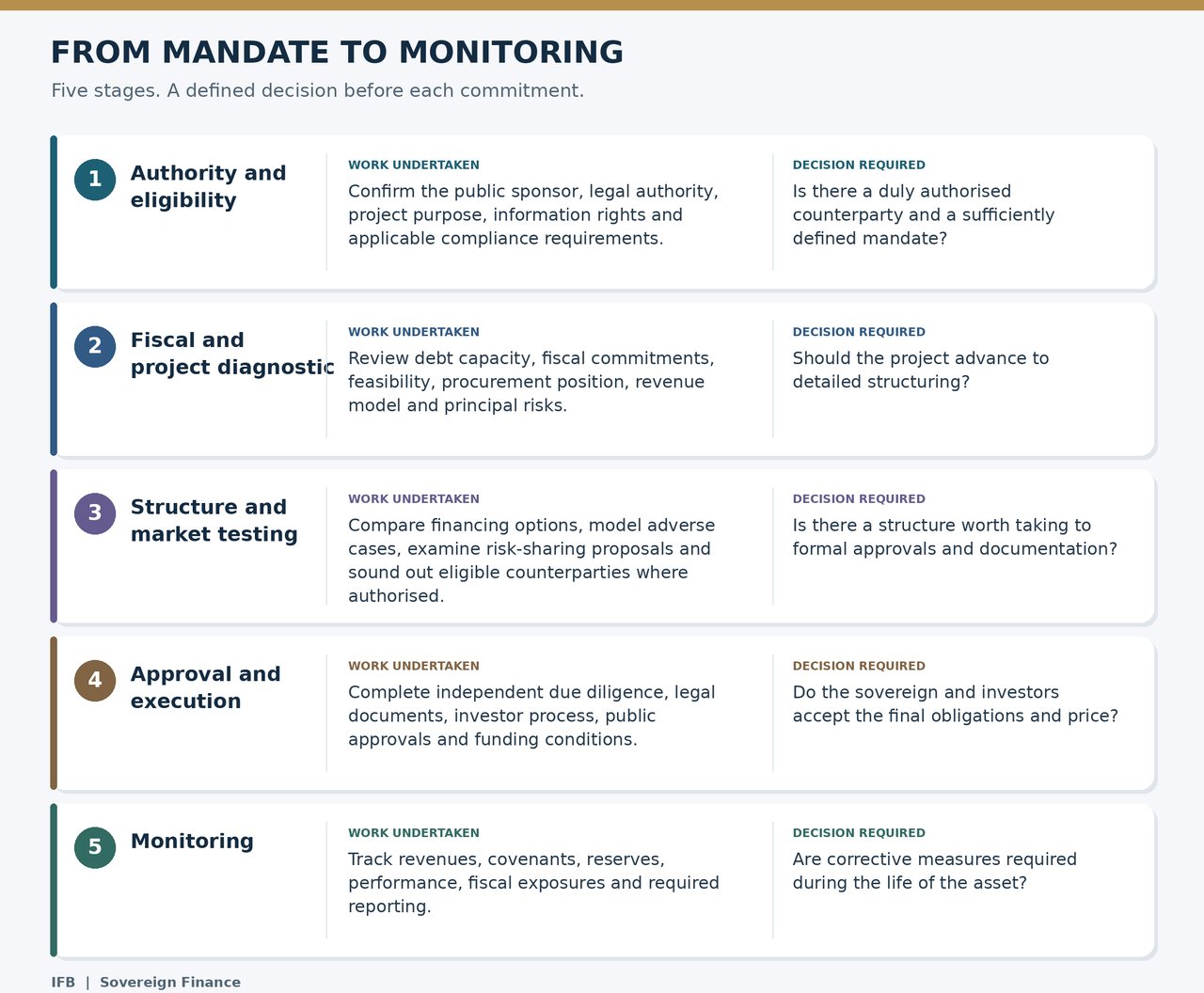
The sequence is deliberate. An investor presentation is not a substitute for authority, feasibility, debt analysis or procurement. Market appetite established before those matters are settled is indicative at best.
What the sovereign receives
The initial mandate would produce a National Development Capital Blueprint tailored to the identified asset or portfolio. Its proposed scope comprises:
- A statement of the project’s public purpose, economic rationale and financing requirement.
- An assessment of sponsor authority, approvals and principal legal constraints.
- A map of existing and proposed sovereign obligations.
- A comparison of realistic funding routes, including conventional alternatives.
- An indicative capital structure and allocation of material risks.
- A preliminary cash-flow model with defined sensitivities.
- A domestic and international investor eligibility assessment.
- A register of information, approvals and independent reviews still required.
- A proposed execution sequence with decision gates and reasons to stop.
The Blueprint is a basis for a sovereign decision, not an investment commitment or a substitute for the final opinions, approvals and transaction documents.
An invitation to examine a defined mandate
IFB invites duly authorised ministries, debt-management offices, sovereign investment institutions and public enterprises to present a specific project or investment programme for confidential preliminary assessment. The initial submission should identify the responsible institution, the asset, estimated capital requirement, proposed source of repayment, current preparation status, existing public commitments and the decision the government seeks to make.
A sovereign financing proposal should leave the State with a productive asset and obligations it understands and can sustain. That is the standard against which this Facility is designed to be judged.
All services and any resulting transaction are subject to mandate acceptance, applicable law and regulation, compliance and sanctions review, independent due diligence, internal approvals, market conditions and the decisions of participating investors. IFB does not represent that a project will obtain financing, a particular rating, capital protection, a specified tenor or a reduction in funding cost.