
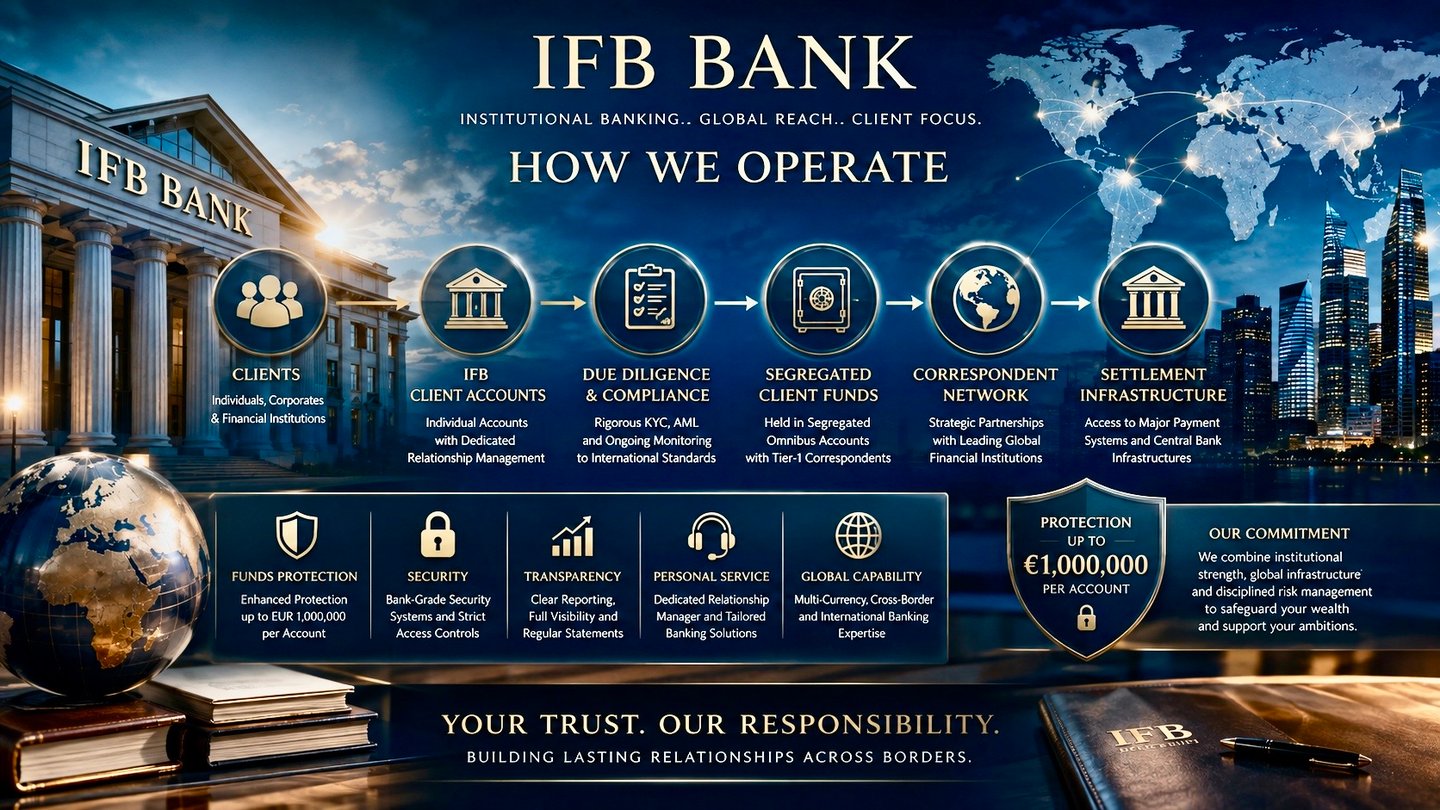
How we operate as Investment Bank
Indirect Settlement Through Correspondent or Respondent Banking
International banking does not require every bank to maintain a direct settlement account with every central bank or payment system in which its transactions ultimately settle. A substantial part of cross-border banking instead operates through correspondent and respondent banking relationships.

What Is Indirect Settlement?
Under a direct settlement model, a bank participates directly in a payment infrastructure and settles transactions through its own account with the relevant central bank or settlement institution.
Under indirect settlement, the bank uses another regulated banking institution as its correspondent or settlement bank. The correspondent maintains the relevant settlement account and executes settlement on behalf of the respondent bank.
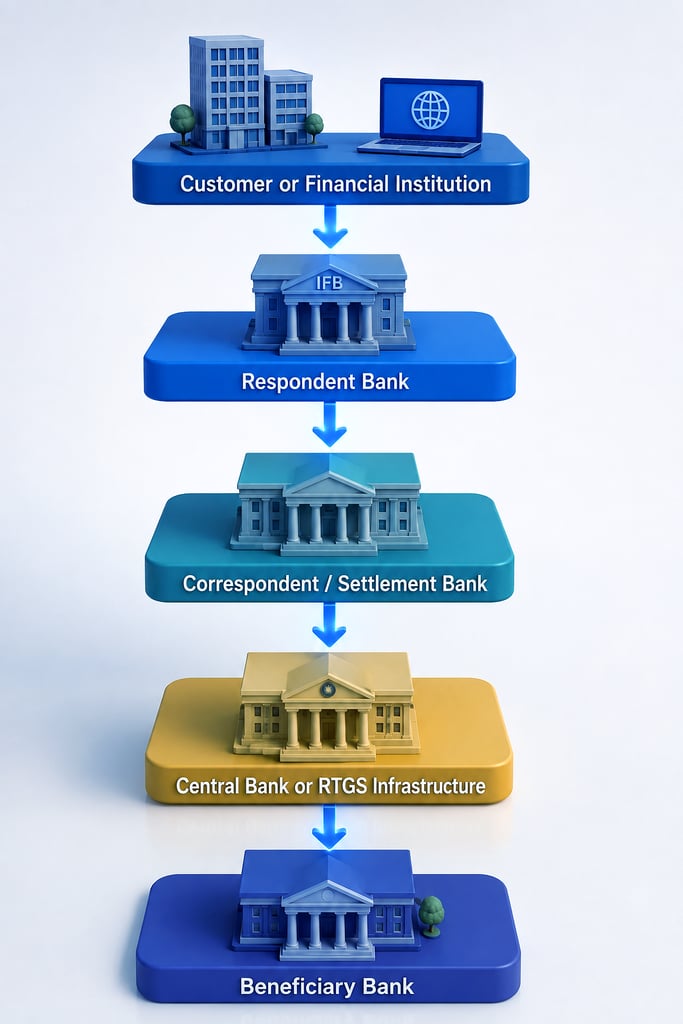
The structure can be illustrated simply:
The respondent bank may maintain a nostro account with its correspondent. Conversely, from the correspondent bank’s perspective, that account constitutes a vostro account.
A Conventional Banking Architecture
Indirect settlement is not an alternative to the regulated banking system. It is an integral part of it.
A bank may provide international banking, investment banking, treasury and payment services without being a direct participant in every domestic or international settlement infrastructure relevant to its business. Settlement can instead be effected through appropriately selected correspondent banks with access to the required currency and payment system.
This architecture is particularly important in cross-border banking because no commercially realistic banking institution maintains direct access to every payment and settlement system worldwide.
Correspondent and Respondent Banks
The terminology describes the relationship from opposite perspectives.
- The correspondent bank provides banking, clearing or settlement services to another financial institution.
- The respondent bank uses those services to facilitate transactions for itself or its customers.
Depending upon the relationship, correspondent services may include:
- nostro/vostro account facilities;
- international payment settlement;
- SWIFT-based payment processing;
- foreign-exchange transactions;
- liquidity and treasury services;
- securities settlement and custody; and
- access to domestic or international clearing infrastructure.
Settlement Remains Settlement
The use of an intermediary does not alter the fundamental requirement for genuine settlement.
A payment instruction, SWIFT message or other electronic communication is not itself the underlying money. Where final settlement is required, the transaction must ultimately pass through the appropriate banking, clearing or settlement infrastructure.
Indirect settlement therefore concerns how access to settlement infrastructure is organised, not whether settlement occurs.
IFB’s International Banking Architecture
International Finance Bank structures its international banking relationships around regulated banking and correspondent infrastructure appropriate to the currencies, jurisdictions and transactions concerned.
This architecture permits international banking operations without requiring direct participation in every individual central-bank or domestic settlement system. Where indirect settlement is employed, the relevant correspondent or settlement institution provides the connection between the banking relationship and the applicable settlement infrastructure.
The result is a conventional institutional model: banking at the respondent level, correspondent access at the settlement level, and final settlement through established financial-market infrastructure.

Segregated Omnibus Accounts in International and Investment Banking
International and investment banking frequently relies upon account structures that distinguish between the bank’s own assets and funds attributable to its clients. One established model is the use of segregated omnibus accounts with correspondent, custodian or settlement institutions.
What Is a Segregated Omnibus Account?
A segregated omnibus account is an account maintained by a bank or financial institution with another financial institution for the collective holding or settlement of funds attributable to multiple underlying clients.
The account is omnibus because assets or funds relating to more than one underlying client may be held within the same external account.
It is segregated because the account is designated and operated separately from accounts used for the institution’s own proprietary funds, subject to the applicable contractual, regulatory and legal framework.
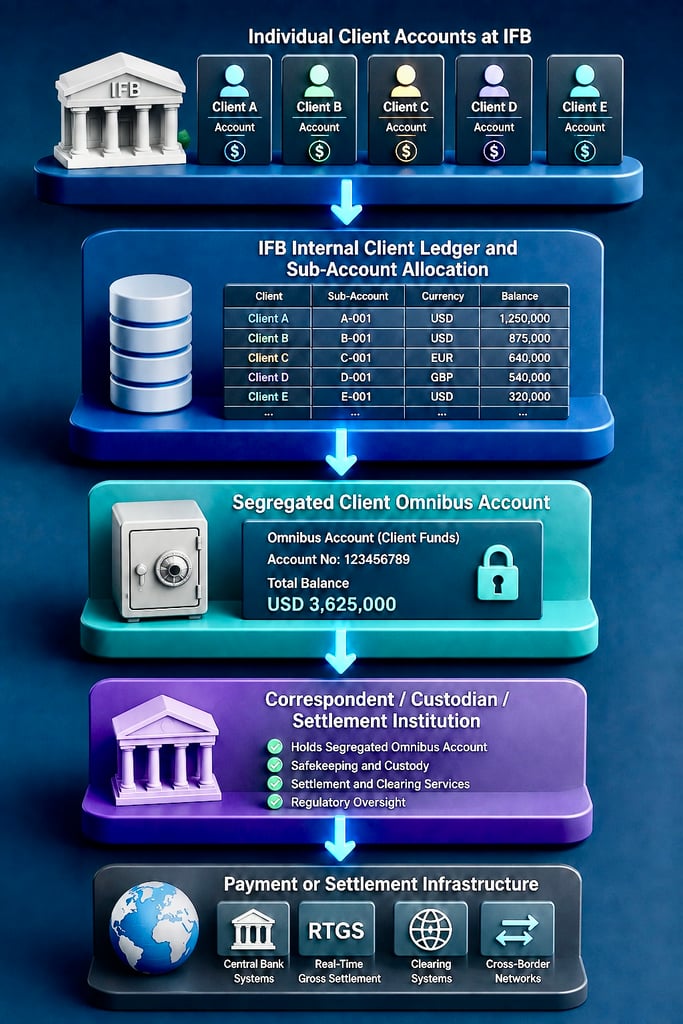
The basic architecture can be represented as:
One External Account, Individual Internal Accounts
The essential distinction is between the external settlement account and the individual client account recorded in the bank’s books and records.
A correspondent or settlement bank does not necessarily maintain a separate external nostro account for every underlying customer of the respondent bank. Instead, client funds may be aggregated within a designated omnibus account, while the respondent bank maintains the underlying allocation through its own books, records and client-account ledger.
Accordingly, the omnibus structure does not mean that individual client balances cease to be identifiable. The respondent institution maintains the records necessary to attribute balances and transactions to the respective underlying accounts.
Segregation From the Bank’s Proprietary Funds
A central feature of the structure is the separation of client-related funds from the bank’s own operating or proprietary funds.
This distinction is important. An omnibus account used for client funds should not be confused with the bank’s proprietary treasury account merely because multiple underlying balances are consolidated at the correspondent or custodian level.
The precise legal consequences of segregation, including ownership, insolvency treatment and protection against claims of third-party creditors, depend upon the governing law, account documentation and regulatory regime. Operational segregation should therefore not be confused with a universal statutory deposit-protection or trust arrangement.
Why Investment Banks Use Omnibus Structures
Omnibus structures are widely used across investment banking, brokerage, custody, securities and international settlement because they permit institutions to combine individual client accounting with efficient institutional settlement.
Rather than requiring a separate correspondent or settlement account for every customer, the institution can maintain a controlled number of external accounts while preserving individual customer positions within its internal ledger.
This architecture can facilitate:
- efficient correspondent and settlement relationships;
- centralised liquidity management;
- multi-currency banking;
- reconciliation of incoming and outgoing transactions;
- institutional custody and securities settlement;
- operational scalability; and
- separation between client-related and proprietary balances.
IFB’s Account Architecture
International Finance Bank employs a segregated omnibus structure for the external holding and settlement of client-related funds within its correspondent banking architecture.
Each IFB client maintains an individual account relationship with the Bank. The corresponding balance and transaction history are recorded and attributable to that client within IFB’s banking and accounting systems.
At the external banking level, funds may be maintained collectively through designated segregated omnibus accounts with correspondent, custodian or settlement institutions rather than through a separate external correspondent account opened in the name of every individual IFB client.
This produces two distinct accounting layers:
- Client Level: individual account, balance, transaction history and client attribution maintained by IFB.
- Settlement Level: aggregated client funds maintained through designated segregated omnibus accounts within the Bank’s external correspondent and settlement infrastructure.
Established Institutional Banking Practice
The distinction between beneficial client attribution and external omnibus settlement is a longstanding feature of institutional finance.
It enables an investment bank to maintain individual banking relationships with its clients while using the institutional infrastructure of correspondent banks, custodians and settlement providers for the external movement and safekeeping of funds.
For IFB, the principle is straightforward:
Individual accounts at the client level. Segregation at the institutional level. Consolidated infrastructure at the settlement level.
This structure combines individual client accounting with the operational efficiency required for international investment and correspondent banking.

Enhanced Protection of Client Funds
Up to EUR 1,000,000 of Protection per Account
International Finance Bank is structured for clients whose banking requirements extend beyond conventional retail banking. This is reflected not only in the Bank’s account architecture and correspondent relationships, but also in the protection framework associated with each qualifying account.
Subject to the applicable terms, conditions, exclusions and limits of the relevant protection arrangement, eligible funds maintained with IFB are protected up to EUR 1,000,000 per account.
This enhanced protection forms part of the institutional banking infrastructure supporting the Bank’s client-account model.
Why IFB Charges an Annual Account Fee
IFB is not structured as a mass-market retail bank. Each account entails a substantially different operational and compliance framework from that ordinarily associated with a conventional current account.
Accordingly, IFB charges an annual account, administration and infrastructure fee of EUR 25,000 per account.
The annual fee contributes to the institutional infrastructure required to maintain the account relationship, including:
- client onboarding and ongoing compliance administration;
- KYC, AML and transaction-monitoring processes;
- maintenance of individual client ledger and sub-account records;
- correspondent and settlement banking infrastructure;
- segregated client-fund architecture;
- account administration and reconciliation;
- institutional transaction processing; and
- the applicable enhanced client-fund protection framework.
The fee should therefore not be understood as an ordinary retail account-maintenance charge. It reflects the substantially greater infrastructure associated with maintaining an institutional banking relationship and the corresponding account architecture.
Protection Beyond Conventional Deposit-Banking Limits
Conventional statutory deposit-guarantee arrangements in many jurisdictions provide considerably lower protection ceilings. IFB’s client-account model is designed for substantially larger banking relationships and therefore incorporates an enhanced protection framework with protection of eligible funds up to EUR 1,000,000 per account, subject to its governing terms.
Importantly, this protection should not be confused with a statutory European Union deposit-guarantee scheme unless the relevant account is expressly covered by such a scheme. The legal basis, scope, exclusions and claims procedure applicable to IFB’s protection arrangement are governed by the specific documentation relating to that arrangement.
Protection for Balances Exceeding EUR 1,000,000
For clients maintaining balances exceeding EUR 1,000,000, IFB may arrange additional protection above the standard protection limit, subject to individual assessment, availability and the terms of the applicable protection arrangement.
Such enhanced protection may be structured according to the amount maintained, the nature of the account, the currencies involved and the client’s individual banking requirements. Additional protection is subject to separate fees, which are determined according to the amount and scope of protection required.
Accordingly, clients intending to maintain substantial balances with the Bank may request a protection structure extending beyond EUR 1,000,000. Any such arrangement must be expressly agreed and documented in advance and remains subject to the applicable terms, conditions, exclusions, limits and eligibility requirements.
This enables IFB to accommodate larger institutional and private banking relationships without treating EUR 1,000,000 as an absolute ceiling on the amount for which protection may be arranged.
Institutional Banking Rather Than Retail Banking
The combination of individual client accounting, segregated omnibus structures, correspondent settlement infrastructure and enhanced protection necessarily carries a different cost structure from conventional retail banking.
IFB has deliberately adopted this model rather than competing on the basis of low-cost mass-market accounts.
The principle is straightforward: institutional account infrastructure, enhanced protection and international banking capability entail institutional rather than retail pricing.