

Cross-border treasury and banking infrastructure for internationally active corporates
IFB serves qualified businesses whose treasury requirements extend beyond standard domestic banking frameworks. We provide multi-currency banking, cross-border payment execution, liquidity support and relationship-led service for corporates operating across jurisdictions, counterparties and settlement environments.
International treasury becomes materially more complex once a business manages multiple currencies, international supplier flows, cross-border settlements and multi-entity structures. In that environment, banking must provide more than account access. It must provide execution reliability, operational clarity and dependable control.
Banking Architecture Before Banking Products
International treasury should not evolve by accumulation. Where banking relationships are opened reactively, one per market, one per counterparty, one per crisis, the result is fragmentation rather than diversification. The company ends up administering banks instead of managing liquidity.
A coherent architecture assigns every relationship a defined function and holds it to that function. Operating accounts carry commercial flow. Treasury accounts hold reserve. Custody sits separately from settlement. Trade instruments run through the institution with the correspondent reach to execute them. Nothing is duplicated without a reason, and nothing critical depends on a single point of failure.
The discipline pays for itself in four places. Reconciliation becomes mechanical rather than forensic. Payment execution improves because each flow runs through the channel built for it. Liquidity becomes visible in aggregate rather than as a set of balances to be assembled by hand. And counterparty risk becomes a decision rather than an accident of history.
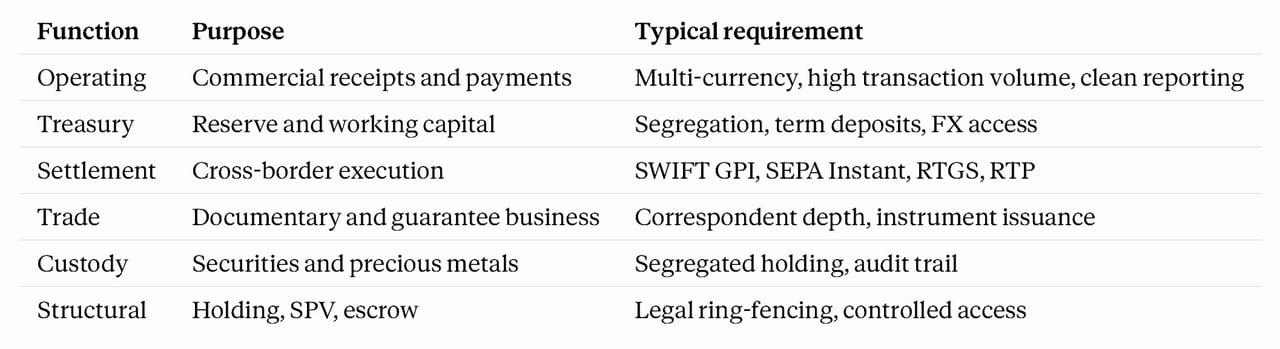
The table above is a starting point, not a template. The correct architecture depends on where the business trades, how it is owned, and which settlement environments it actually touches. We assess that before recommending accounts.
IFB’s legal-entity banking framework is designed around those requirements. The bank describes multi-tiered account structures for operational, treasury and custodial use, multi-currency accounts with SWIFT and related capabilities, and payment infrastructure including SWIFT GPI, SEPA Instant, RTGS, RTP and internal book transfers. It also refers to customised transaction monitoring and reporting dashboards, tailored liquidity frameworks, and FX spot, forward and swap arrangements upon request.
This treasury path is built for founders, owner-managers and internationally active principals whose businesses have moved beyond the limits of ordinary domestic banking. Once a company begins operating across jurisdictions, counterparties and currencies, treasury stops being an administrative afterthought and becomes part of the firm’s commercial control architecture.
It is particularly suited to businesses requiring multi-currency operating accounts in order to manage revenue streams, supplier payments, payroll, working capital and treasury balances across different markets. For growth companies and founder-led groups, this is not merely a question of convenience. It is a question of preserving agility, reducing avoidable FX friction and retaining control over cash as the business scales.
It is equally relevant where the business requires international payment execution with greater speed, clarity and reliability than conventional banking relationships are often willing or able to provide. Founders tend to notice very quickly when banking becomes an impediment to commercial momentum. Delayed settlements, fragmented service channels and opaque escalation processes are not minor irritants. They are operational failures. A more suitable treasury framework supports cross-border payments with greater discipline and fewer unnecessary obstacles.
This path also suits corporates requiring liquidity visibility across borders. As founder-led businesses expand, cash often becomes dispersed across entities, jurisdictions and banking relationships. That fragmentation creates strategic weakness. Management needs a clearer view of where liquidity sits, how it moves and where funding pressure may emerge. Better visibility leads to better judgement, particularly when the business is balancing growth, investment, treasury reserves and cross-border obligations at the same time.
- For companies with multiple entities, regional operations or more developed internal governance, this path is also appropriate where structured treasury administration becomes necessary. At a certain stage of growth, informal arrangements cease to suffice. The business needs clearer account segmentation, stronger approval logic, more coherent banking architecture and processes that can support scale without descending into disorder. That is especially true where founders are moving from entrepreneurial improvisation to more institutional operating discipline.
- It is also well suited to businesses requiring reconciliation and reporting support as treasury becomes more demanding. International operations increase the burden on finance teams. Payment flows multiply, counterparties diversify, and management requires cleaner reporting in order to make sound decisions. A banking relationship that supports stronger reconciliation logic, reporting clarity and operational transparency is therefore commercially valuable, not merely administratively desirable.
- Finally, this path is intended for corporates seeking a more responsive banking relationship for international operations. Founder-led businesses often outgrow generic banking long before the bank notices. What they require is not theatrical relationship management, but accountable human counterparts, sensible escalation, and an institution that understands that treasury is integral to execution, not peripheral to it.
In substance, this treasury path is for businesses that need banking to keep pace with ambition. It is designed for internationally active corporates that require more control, more visibility and more reliable cross-border execution as they grow.
Our onboarding process is documentation-led and suitability-based. We assess the corporate profile, jurisdictional footprint, ownership structure, transaction rationale and treasury use case before activation. This approach is intended to establish a durable banking relationship rather than a purely transactional account opening.