
Asset Protection and Jurisdictional Risk
This page is published for informational purposes and describes developments in financial supervision across several jurisdictions. It does not constitute advice, a recommendation, or an invitation to establish a banking relationship with IFB.
In the next five years, money architecture will be reshaped more by AI-driven supervision tools than interest-rate policy. These include account registries, programmable central-bank money, and unified crisis-management systems. All these measures increase state oversight and control over private liquidity. Below are the key initiatives, their timelines, and the expected level of control they may provide.

Why wait? Diversify now.
Supervisory Architecture, 2025 to 2027
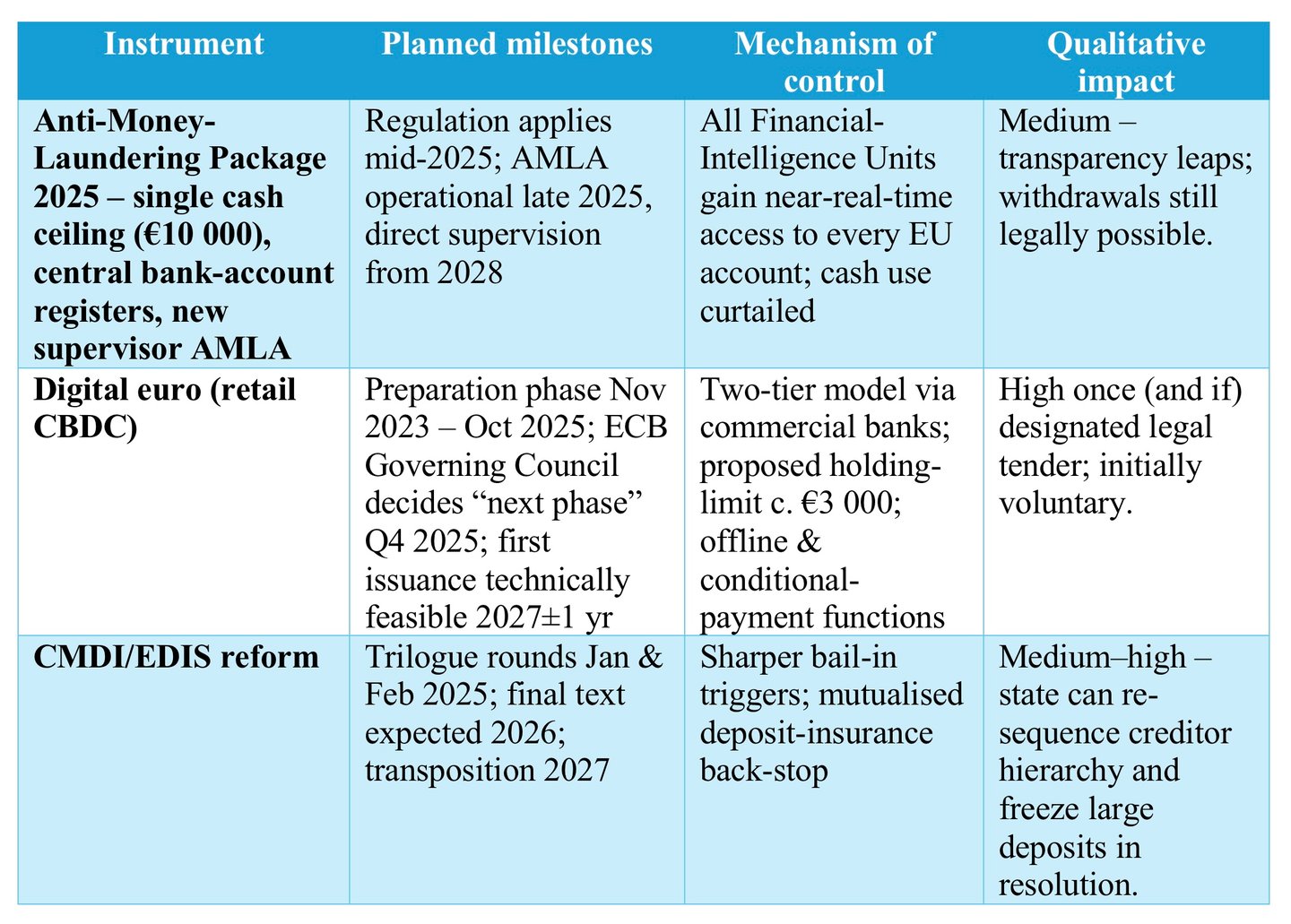
Reading of intent: Brussels is engineering granular observability first (registries), programmable settlement second (CBDC) and an integrated failure regime third. The sequence suggests deliberate scaffolding for more active steering of flows post-2027.
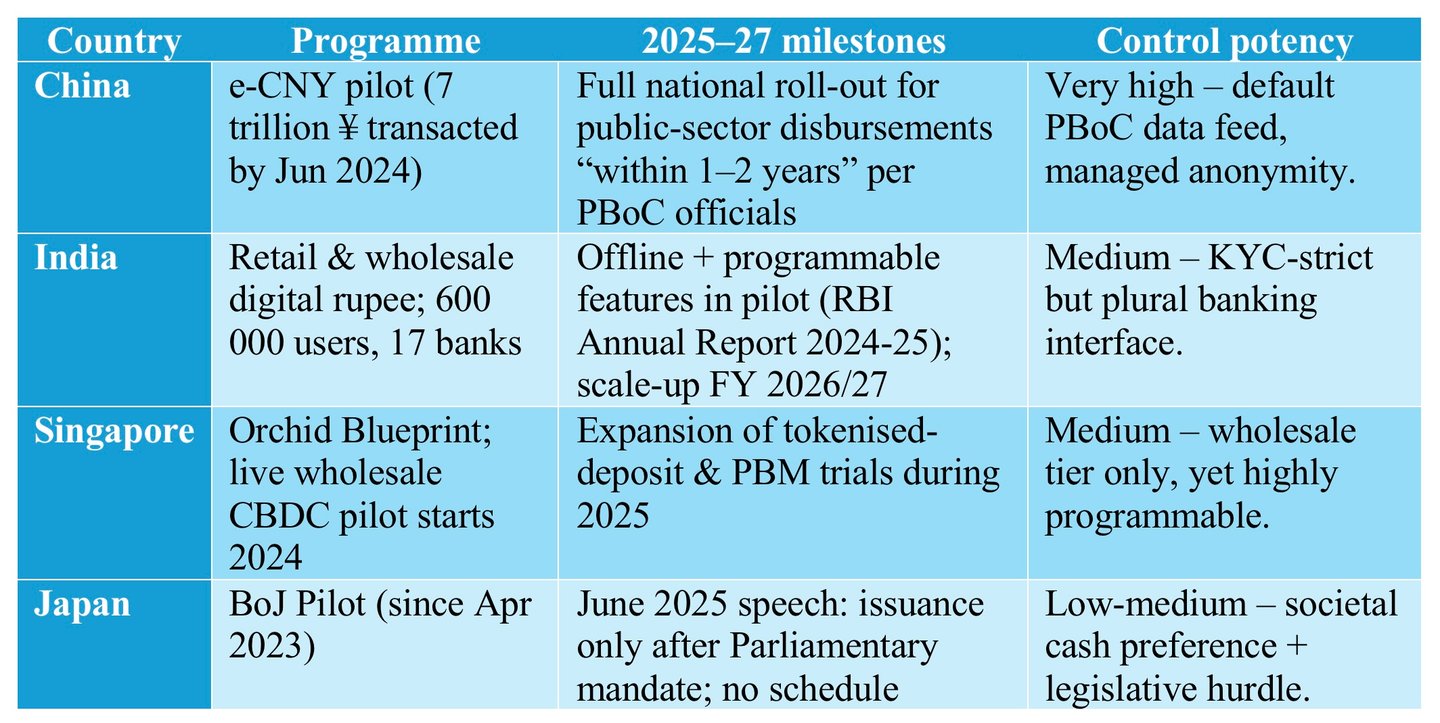
Take-away: Asia is moving fastest on retail issuance, but along divergent paths. China is scaling a system built for observability, India is building plural interfaces on strict KYC, Singapore is confining programmability to the wholesale tier, and Japan has made issuance conditional on a parliamentary mandate that does not yet exist. Convergence on a single Asian model before 2030 is unlikely.
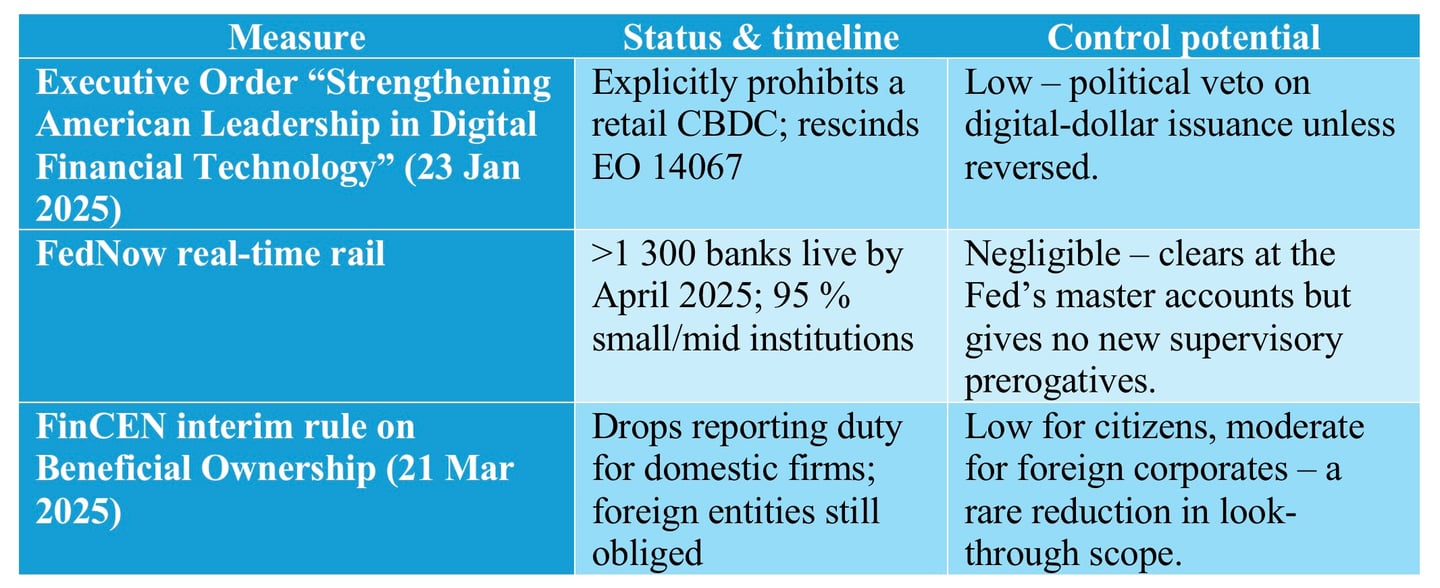
Take-away: Washington is pivoting towards stable-coin and private dollar solutions while consciously eschewing a surveillance-prone CBDC. Hence the probability of a retail digital dollar before 2030 is materially below one in three.
Europe is unmistakably on the vanguard… The United States presently charts the contrarian course.
Mitigation repertoire for depositors
- Jurisdictional diversification – hold operating cash in at least two legal areas with divergent regulatory philosophies; historical correlation of intrusive measures EU-US ≈ 0.3.
- Non-bank stores of value – short-dated sovereign bills, bullion, or allocated precious-metal ETFs outside banking balance sheets; trade-off: settlement latency and custody cost.
- Cryptographic self-custody – Bitcoin/Ethereum held off-exchange preserves dispositional freedom but introduces price volatility and, in the EU, forthcoming MiCA reporting duties (from 2026).
- Bespoke banking covenants – negotiate elevated cash-withdrawal limits and minimum notice periods in private-bank terms (feasible mainly >€1 m relationships; estimated <20 % success rate).
- Legislative early-warning system – subscribe to Commission work-program RSS feeds, ECB consultation portals, and Federal Register alerts; response latency can thus fall below 24 h.
Concluding synthesis
Europe is unmistakably on the vanguard: by 2025, authorities will “see” virtually every account and by circa 2027 may programme portions of retail money. China and, increasingly, India provide live demonstrations of how such visibility morphs into behavioural steering (subsidy tokens, conditional vouchers). The United States presently charts the contrarian course, elevating private stablecoins while outlawing a CBDC—yet such bans remain politically reversible.
Hence, from a prudential vantage, regulatory diversification now ranks alongside asset allocation as a cornerstone of monetary self-determination.
Readers who wish to discuss these developments may request a videoconference. Any such request is made on the reader's own initiative. Participation does not constitute an offer or commitment by IFB to provide any regulated banking or financial service, and creates no entitlement to an account or banking relationship.
Do you still have questions?
Please book a Zoom Videoconference here: