

What is anti-money laundering?
Fighting money laundering and terrorist financing contributes to global security, the financial system's integrity, and sustainable growth. Laws to combat money laundering and the funding of terrorism are designed to prevent the financial market from being misused for these purposes.
The European Union and many Countries adopted robust legislation to fight against money laundering and terrorist financing, contributing to those international efforts. Competent bodies ensure practical application of this legislation by reviewing the transposition of the plan and working with networks of competent authorities.
IFB is licensed and supervised in the Union of the Comoros, Autonomous Island of Anjouan, by the Anjouan Offshore Finance Authority under licence L1149. Our AML/CFT programme is built on the FATF Forty Recommendations, which are the standard against which national regimes are themselves assessed.
Other frameworks apply where our counterparties sit. Correspondent relationships bring United States requirements under the Bank Secrecy Act into scope indirectly, and EU-facing activity engages the European framework. A programme built only to the local minimum does not survive correspondent banking diligence, which is why ours is not.
Our programme comprises:
- Written approval by a senior manager.
- A risk-based customer identification programme sufficient to form a reasonable belief as to the true identity of each customer.
- Detection and reporting of suspicious activity.
- Independent testing of implementation.
- A named AML Compliance Officer with published contact details.
- Ongoing training of relevant personnel.
- Risk-based ongoing due diligence, including beneficial ownership of legal-entity customers, and monitoring to keep customer information current.
The purpose of the AML rules is to help detect and report suspicious activity, including the predicate offences to money laundering and terrorist financings, such as securities fraud and market manipulation.
The competent authority reviews a firm’s compliance with AML rules which sets forth minimum standards for a firm’s written AML compliance program.
- The program has to be approved in writing by a senior manager.
- It must be reasonably designed to ensure the firm detects and reports suspicious activity.
- It must be reasonably designed to achieve compliance with the AML Rules, including having a risk-based customer identification program (CIP) that enables the Bank to form a reasonable belief that it knows the true identity of its customers.
- It must be independently tested to ensure proper implementation of the program.
- Each Bank must submit contact information for its AML Compliance Officer.
- Ongoing training must be provided to appropriate personnel.
- The program must include appropriate risk-based procedures for conducting ongoing customer due diligence, including (i) understanding the nature and purpose of customer relationships to develop a customer risk profile; and (ii) conducting ongoing monitoring to identify and report suspicious transactions and, on a risk basis, to maintain and update customer information, including information regarding the beneficial owners of legal entity customers.
In 1989, the Financial Action Task Force (FATF) was created to combat money laundering. The FATF organisation sets the framework for anti-money laundering (AML) policies and supervises countries to make sure that they comply. Individual countries also have supervisory schemes that oversee national institutions. The UN, World Bank and International Monetary Fund all have AML schemes.
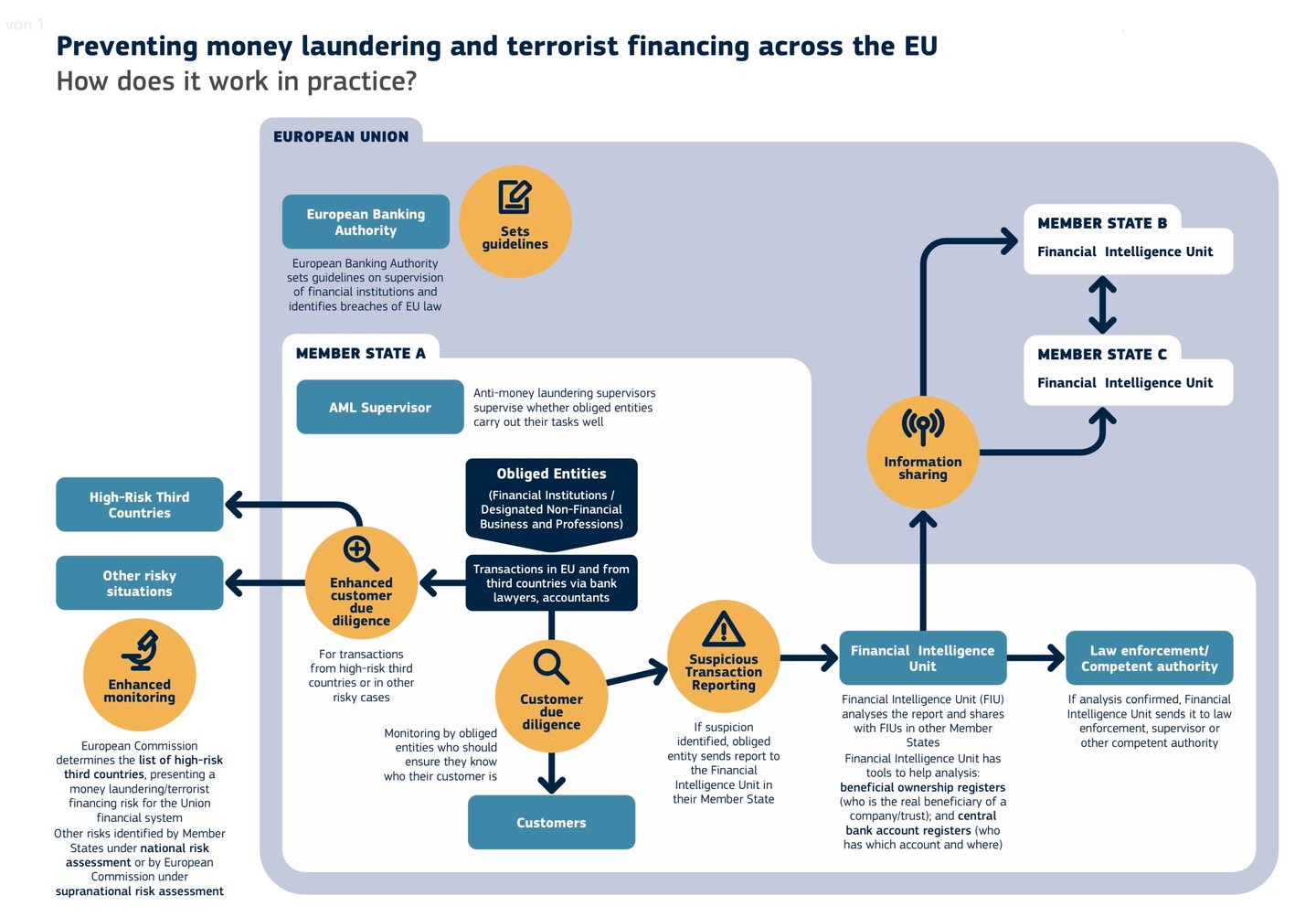
Anti-money laundering is a framework for putting best practices into detecting suspicious activity. The easier it is for criminals to spend illegal money undetected, the more likely they will commit crimes in the future. As a result, AML regulations make “obligated entities” aware of red flags to watch out for and ensure that such institutions proactively monitor their clients’ activities. But who exactly are the “obligated entities?”
Obligated entities refer to institutions that encounter financial transactions, which money launderers could target. These include banks, payment processors, and gaming or gambling businesses. In the EU, the European Banking Authority sets guidelines and regulations on supervision. Anti-money laundering supervisors then monitor each institution to see how effectively they carry out their AML tasks.
Institutions have to comply with customer due diligence. The European framework has changed shape. The directive-based architecture is being replaced by the 2024 AML package: Regulation (EU) 2024/1624 setting directly applicable obligations, Directive (EU) 2024/1640 covering supervision and financial intelligence units, and Regulation (EU) 2024/1620 establishing the Anti-Money Laundering Authority in Frankfurt.
The practical consequences for obliged entities are a single directly applicable rulebook rather than twenty-seven transpositions, an EU-level supervisor with direct competence over selected institutions, and a harmonised cash payment limit. The package phases in, so confirm the applicable date for any specific obligation rather than assuming a single switchover.
How banking AML works
As the financial system's foundation, banks need a sharp eye to spot suspicious behaviour. Like all institutions, banking AML policies are shaped by the framework set by the FATF. Frontline employees are trained in anti-money laundering techniques and are legally required to report suspicious activity.
Banks may hire employees whose purpose is to boost anti-money laundering practices. These security experts are known as AML compliance officers. In addition, AML banking is supported by three key factors: identity checks, AML holding periods, and AML transaction monitoring software.
Identity checks
Specific institutions, such as banks, must follow Know Your Customer (KYC) processes. These are the steps that banks must take to verify the identity of their customers. Although anti-money laundering policies provide the framework, individual banks are responsible for their customers, and it’s their responsibility to flag high-risk transactions.
So what do banks verify? Know Your Customer policies require banks to verify the customer’s name, date of birth, address, and occasionally additional information, such as occupation. Banks typically ask customers to verify their identity with ID documents when opening an account. Banks have recently been using biometric identification, such as face or voice recognition and fingerprint scans.
Settlement and release controls
Incoming funds are released against cleared settlement, not against advice of payment. Where a credit is unusual for the account, release may be held pending review. This is an internal control and a settlement-risk measure. It is not a regulatory holding period, and no AML framework prescribes one.
AML transaction monitoring software
Many banks have millions of customers and oversee millions of transactions. With such a high volume, it’s impossible to monitor every single transaction manually. That’s where AML transaction monitoring software comes in—this technology allows banks and other financial institutions to monitor transactions daily or in real-time.
Such software combines different sources of information, such as the account holder’s history, risk assessment, and the details of individual transactions such as the total sum of the money, countries involved, and the nature of the purchase. Transactions can include cash deposits, wire transfers, and withdrawals. When a transaction is deemed to be high risk, it’s flagged by the system as suspicious activity.
We follow the Wolfsberg Group Principles.
The Wolfsberg Group is an association of global banks that aims to develop frameworks and guidance for managing financial crime risks, particularly Know Your Customer, Anti-Money Laundering and Counter-Terrorist Financing policies. The Group came together in 2000, at the Château Wolfsberg in north-eastern Switzerland, in the company of representatives from Transparency International, including Stanley Morris and Professor Mark Pieth of the University of Basel, to work on drafting anti-money laundering guidelines for Private Banking. The Wolfsberg Anti-Money Laundering (AML) Principles for Private Banking were subsequently published in October 2000, revised in May 2002 and again, most recently in June 2012.

Transaction Monitoring Systems (TMS)
Transaction Monitoring Systems (TMS) are essential tools used by financial institutions and regulatory bodies to oversee and analyze transactions happening within the banking system. They are designed to identify potentially suspicious or fraudulent activities that may indicate money laundering, terrorism financing, or other financial crimes.
Here's how they typically work:
- Data Collection: TMS gather data from various sources within the bank's system. This data includes but is not limited to transaction details such as the amount, date and time, parties involved, and the nature of the transaction.
- Risk Profiling: The TMS uses the collected data to create risk profiles for customers and transactions. These profiles are based on a variety of factors, such as the customer's history, the types of transactions they typically conduct, and their geographic location.
- Rule-Based Monitoring: The system applies a set of pre-defined rules to each transaction. These rules are designed to flag potentially suspicious activities. For example, transactions above a certain value might be flagged, or multiple transactions in a short period of time.
- Anomaly Detection: In addition to rule-based monitoring, many systems also use statistical models or machine learning algorithms to identify anomalies – transactions that deviate significantly from the norm. This could include unusual patterns of transactions or activities that don't match the customer's typical behavior.
- Alert Generation: When a transaction is flagged as potentially suspicious, the system generates an alert. This alert is then reviewed by a compliance officer or a team of investigators within the bank.
- Investigation and Reporting: If, upon review, the transaction is deemed suspicious, the bank will conduct a more thorough investigation. Depending on the outcome of this investigation, the bank may be required to file a Suspicious Activity Report (SAR) with the relevant regulatory authorities.
- Continuous Learning: The feedback from the investigation process is used to continually improve and update the rules and algorithms used by the TMS, enhancing its ability to accurately detect suspicious activities in the future.
By utilizing a Transaction Monitoring System, banks can better manage their risk exposure, ensure compliance with regulations, and help combat financial crimes.

CFT Counter Financing of Terrorism
IFB Bank’s approach to Counter Financing of Terrorism (CFT) is underpinned by a sophisticated, multi-tiered operational framework that integrates meticulous risk assessment, state-of-the-art technology, and proactive regulatory collaboration. The following exposition elucidates the intricate workings of our CFT system:
Foundational Pillars and Risk-Based Approach
Our CFT controls combine customer due diligence at onboarding, continuous transaction monitoring, and escalation to human review on flagged activity. Models are reviewed and recalibrated on a defined cycle against internal outcomes and external typologies.
We publish no detection statistics. Figures of that kind are unverifiable by the reader and meaningless without the underlying methodology. What we will do is answer specific questions from correspondents and regulators, under the appropriate confidentiality.
Enhanced Due Diligence and Transactional Surveillance
Following initial client screening, a series of enhanced due diligence (EDD) procedures are deployed, particularly for high-risk profiles. These measures include:
- Comprehensive Data Analytics: Our proprietary algorithms analyse voluminous datasets in real time, discerning patterns that may indicate unusual financial behaviours. Sophisticated statistical models enable us to flag anomalies that deviate from established transactional norms.
- Behavioural Profiling: By integrating historical transactional data with predictive analytics, we construct detailed behavioural profiles. This enables our system to identify potential red flags early, prompting further manual review when necessary.
- Multi-Layered Verification: To corroborate the legitimacy of flagged transactions, we employ a multi-tiered verification process, leveraging both automated systems and human expertise. This duality ensures that our interventions are both swift and judicious, maintaining high accuracy rates in detection.
Real-Time Monitoring and Automated Interventions
Our operational infrastructure is bolstered by an advanced real-time monitoring system that continuously scans transactional streams. Key components of this system include:
- Artificial Intelligence and Machine Learning: These technologies empower our systems to learn from evolving transaction patterns and adapt to emerging threats. The use of neural networks and pattern recognition algorithms enables us to maintain a vigilant watch over financial flows, with automated interventions activated when pre-defined thresholds are exceeded.
- Immediate Flagging and Escalation: Upon detection of a potential risk, transactions are instantaneously flagged and subjected to a secondary review. This escalation process, combining algorithmic precision with expert oversight, facilitates immediate containment and subsequent investigation.
- Adaptive Algorithms: Our algorithms are continuously updated based on global intelligence inputs and internal performance metrics, ensuring that they remain resilient against new typologies of financial malfeasance.
Collaborative Intelligence and International Partnerships
Recognising that the menace of terrorism financing transcends borders, IFB Bank’s CFT operations are deeply rooted in collaborative intelligence. We actively engage with national regulatory bodies and international financial institutions to exchange insights and best practices. This global network not only reinforces our internal controls but also enhances our adaptive capacity in response to the ever-evolving threat landscape.
- Intelligence Sharing: Regular participation in international forums and secure data exchanges with partner institutions significantly enrich our threat detection capabilities.
- Joint Task Forces: In scenarios where threats are of an unprecedented scale, IFB Bank readily contributes to or forms part of joint task forces dedicated to neutralising terrorism financing, thereby ensuring a united and formidable response.
Proactive Adaptation and Continuous Improvement
The efficacy of our CFT procedures is predicated on an unwavering commitment to continuous improvement. Our dedicated research and development division monitors emerging trends in financial crimes and integrates novel methodologies into our operational protocols. This proactive stance has allowed us to achieve near real-time responsiveness to emerging threats, with contingency success probabilities frequently reaching the upper nineties percentile in internal assessments.
In summary, IFB Bank’s CFT operations are a testament to our unyielding commitment to financial security and regulatory excellence. By intertwining rigorous due diligence, cutting-edge technology, and global collaborative efforts, we have engineered a system that not only detects and deters the financing of terrorism but also continually evolves to address future challenges. This intricate framework is the cornerstone of our endeavour to protect the integrity of the international financial system and to foster a secure environment for our clients and partners alike.

KYP, VoP
At IFB Bank, our integrated security framework forms an impervious bastion against fraud, money laundering, and terrorism financing. This holistic architecture interlaces our advanced Know Your Payee (KYP) procedures, Verification of Payee (VoP) processes, and our comprehensive Counter Financing of Terrorism (CFT) protocols. Together, these measures construct a multi-layered defence that meticulously scrutinises every facet of our financial operations.
Know Your Payee (KYP)
Our KYP procedures signify an evolved paradigm in beneficiary verification. Departing from traditional sender-centric protocols, KYP is dedicated to ensuring that every payee’s identity is unequivocally authenticated. This is achieved through:
- Exhaustive Identity Validation: Every prospective beneficiary is rigorously cross-checked against authoritative databases, utilising both static data and dynamic risk indicators.
- Behavioural and Transactional Profiling: Sophisticated algorithms analyse historical payment data and behavioural patterns to establish a comprehensive risk profile. This allows for early detection of discrepancies that might suggest fraudulent intent.
- Risk-Based Categorisation: By stratifying payees according to risk, our system is able to deploy enhanced scrutiny where warranted, thus fortifying our defences against money laundering and misdirected funds.
Verification of Payee (VoP)
Verification of Payee is not a courtesy. It is a legal obligation under Regulation (EU) 2024/886, the Instant Payments Regulation, which amends the SEPA Regulation (EU) No 260/2012.
Since 9 October 2025 every payment service provider in a euro-area member state that offers credit transfers must provide a VoP check to the payer before authorisation, free of charge. The obligation covers both instant and standard SEPA credit transfers, not merely instant ones. Providers outside the euro area have until 9 July 2027.
How it works:
The payer's provider submits the payee's IBAN and name.
The request is relayed to the payee's provider through the SEPA scheme or a routing and verification mechanism.
The payee's provider checks its records and returns one of four outcomes: match, close match, no match, or unable to verify.
The payer receives the result and decides whether to proceed. The payment is not blocked automatically.
The point that clients most often miss: where the payer authorises a transfer after being warned of a mismatch, the payer bears the liability for funds reaching an unintended recipient. The warning shifts the risk. Read it before you click through it.
The European Payments Council VoP Scheme Rulebook entered into force on 5 October 2025 and governs the inter-provider mechanics.
Counter Financing of Terrorism (CFT) Procedures
Our CFT protocols underpin our entire security framework, reinforcing our commitment to a safe and transparent financial ecosystem. These procedures encompass:
- Rigorous Customer Due Diligence (CDD): In alignment with stringent Know Your Customer (KYC) standards, CFT procedures commence with a thorough vetting of all clients, ensuring that every account is scrutinised from inception.
- Continuous Transaction Monitoring: Employing state-of-the-art artificial intelligence and real-time data analytics, our monitoring systems vigilantly oversee transactional flows to detect and intercept any signs of terrorism financing.
- Adaptive Risk Assessment: Our models, refined continuously through machine learning, offer dynamic risk scoring that adapts to emerging threats. This ensures that our detection rates remain exceptionally high, often exceeding 90% in controlled evaluations.
A Synergistic Shield Against Financial Malfeasance
The seamless integration of KYP, VoP, and CFT measures engenders a robust, interdependent security network that operates on multiple levels:
- Holistic Oversight: By interweaving beneficiary verification, payment instruction analysis, and continuous monitoring, our framework covers every conceivable vulnerability. This multi-dimensional approach ensures that no single point of failure can be exploited.
- Automated and Human-Driven Scrutiny: While our advanced algorithms and machine learning models provide instantaneous detection and response, the irreplaceable value of human expertise is deployed for in-depth review and contextual analysis, thus maximising accuracy.
- Global Compliance and Intelligence Sharing: Our protocols are not insular. We maintain active collaborations with international regulatory bodies and financial institutions, ensuring that our security measures are consistently refined in line with the latest global standards and threat intelligence.
- Adaptive Resilience: The rapid evolution of financial crime demands that our systems are both nimble and anticipatory. Our ongoing investment in research and development guarantees that our security measures adapt dynamically to emerging challenges, thereby sustaining an enviable level of operational excellence.
IFB Bank’s integrated suite of security measures stands as a paragon of vigilance against fraud, money laundering, and terrorism financing. Through the meticulous operation of our KYP, VoP, and CFT protocols, we ensure that every transaction is subjected to rigorous scrutiny, thereby preserving the integrity of the financial system. This multi-layered, synergistic approach not only pre-empts potential threats but also upholds our unwavering commitment to excellence and regulatory compliance in an ever-evolving global landscape.