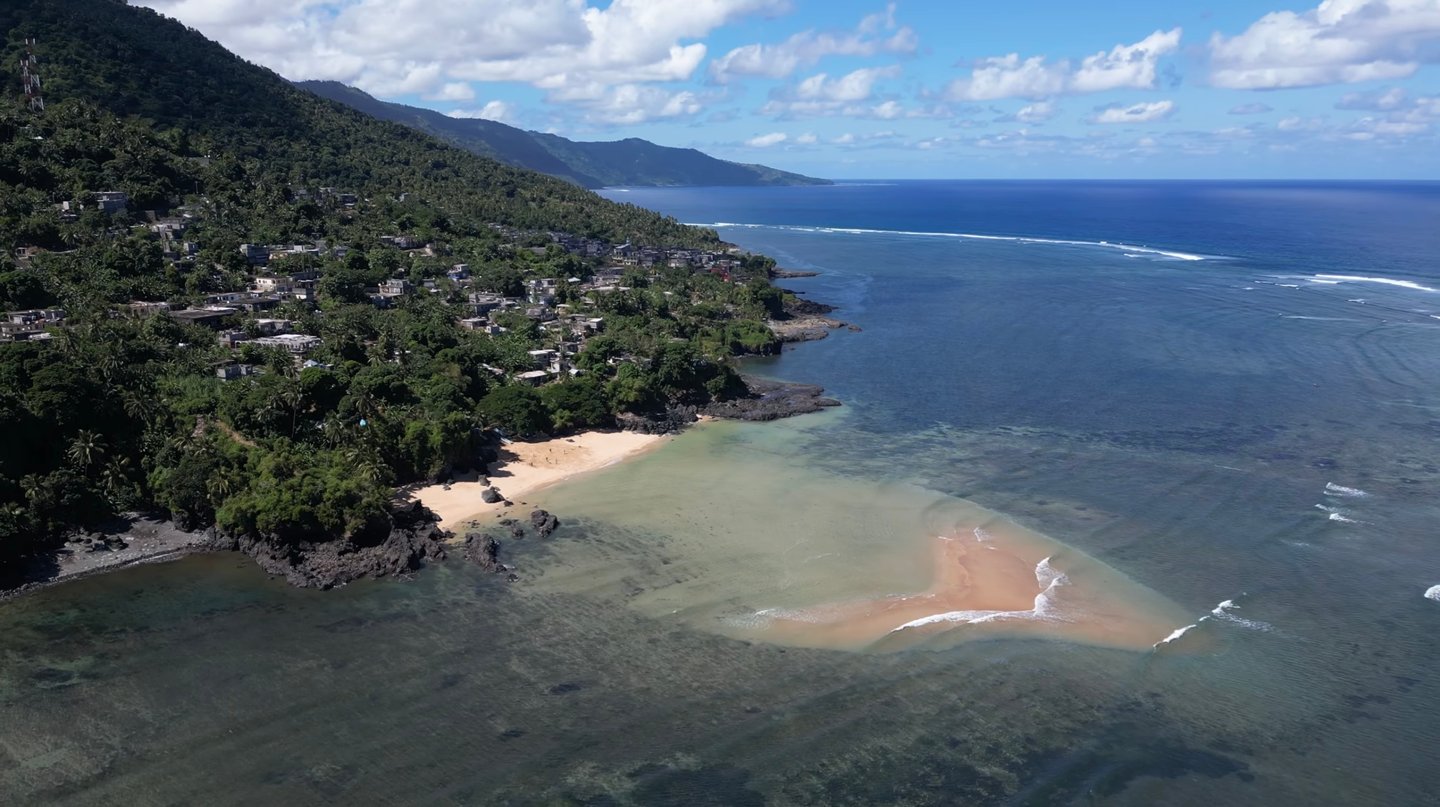
Licensed offshore banking for cross-border private and corporate clients
For internationally active private clients, entrepreneurs, family offices and corporates requiring confidential banking relationships, multijurisdiction execution and direct relationship access.
Established in 2005, IFB provides offshore banking, wealth structuring support, multi-currency account infrastructure and digital onboarding for qualified clients operating across jurisdictions. Our service model combines institutional discipline with responsive human access, enabling efficient execution where standard banking frameworks are often insufficient.

Offshore banking is the holding of a bank account in a jurisdiction other than the client’s country of residence. It is defined by regulatory residency, not by geography.
Clients use it to hold assets across more than one legal system, to secure banking access in more than one settlement environment, and to structure succession and asset protection under a framework suited to their circumstances.
Offshore Banking Demystified
Truths, Strategies, and Global Access
In an increasingly globalised, digitised, and politically volatile world, offshore banking has ceased to be a niche tool of the ultra-wealthy and has become a prudent strategic measure for high-net-worth individuals, international entrepreneurs, and globally mobile families. At IFB Bank, we demystify offshore banking, offering tailored solutions that combine legal certainty, transactional fluidity, and wealth optimisation.
Offshore banking, long the preserve of the ultra-rich and subject to media caricature, has undergone a fundamental transformation. Today it constitutes a working component of international wealth structuring, succession planning and geopolitical risk management. From sovereign wealth funds to internationally mobile entrepreneurs, sophisticated actors hold assets across more than one legal system in order to reduce concentration risk, to secure access to liquidity in more than one settlement environment, and to structure succession under a framework suited to the family concerned. The purpose is diversification of legal exposure, not the avoidance of obligations owed in the client’s own jurisdiction.
At the vanguard of this evolution stands Anjouan, one of the autonomous islands of the Union of the Comoros. Often overlooked or misunderstood, Anjouan offers a unique convergence of accessibility, legal clarity, and institutional flexibility. Through IFB Bank’s established channels and correspondent infrastructure, Anjouan emerges not as a fallback, but as a strategic enabler of bespoke offshore banking architectures.
1. What Is an Offshore Bank Account – and What It Isn’t
Contrary to the disinformation circulated by ill-informed media outlets, offshore banking is not a matter of geography but of regulatory residency. An offshore bank account is simply a financial account held in a jurisdiction other than one’s country of residence—by a non-resident client.
While the term may evoke images of exotic tax havens, many robust financial centres—such as Singapore, Luxembourg, or even the United States—are legitimate offshore jurisdictions when serving foreign clients. In contrast, countries like Canada or Germany may often be mislabelled due to a fundamental misunderstanding of non-resident banking.
2. Why Bank Offshore?
A. Foundational Benefits
- Diversification: Asset dispersion across sovereign boundaries mitigates systemic risks.
- Currency Exposure: Offshore accounts enable multi-currency holdings and natural hedging of currency exposure.
- Investment Access: Offshore structures often provide access to international investment products unavailable domestically.
- Political Risk Mitigation: If a domestic government freezes local assets, offshore reserves remain unaffected.
B. Strategic Depth: Structuring Across Legal Systems
Sophisticated offshore banking is not merely a hedge. It is a structuring discipline used for:
- Tax efficiency via international treaties
- Selection of jurisdictions whose regulatory framework corresponds to the intended activity and scale
- Succession planning under favourable inheritance frameworks
- Asset protection from litigation, expropriation, or currency controls
C. Defensive Objectives
- Hedging against capital controls and expropriation risk
- Ensuring liquidity in hostile legal environments
- Preserving confidentiality under lawful, private structures
- Political neutrality in international dispute zones
D. Structuring Objectives
- Treaty-based planning conducted within the disclosure and reporting obligations applicable to the client
- Currency diversification and foreign exchange efficiency
- Selection of the governing law for probate, trust and succession arrangements
- Structured layering through SPVs, holding companies and captive instruments
Illustration:
A client may value the custody standards and institutional stability of a Swiss private bank while holding assets that are more efficiently booked elsewhere for operational or currency reasons. Booking location, custody relationship and tax treatment are three separate questions. A structure is sound only where all three are addressed openly and where the client’s reporting obligations in the client’s own jurisdiction are met in full.
3. Who Can Open an Offshore Account?
Eligibility is determined case by case. IFB considers applications from clients in jurisdictions in which the Bank may lawfully provide the relevant services, and where the applicant meets:
- Minimum deposit thresholds
- Documentary requirements (KYC, source of wealth, tax ID, proof of address)
- Economic rationale for the account
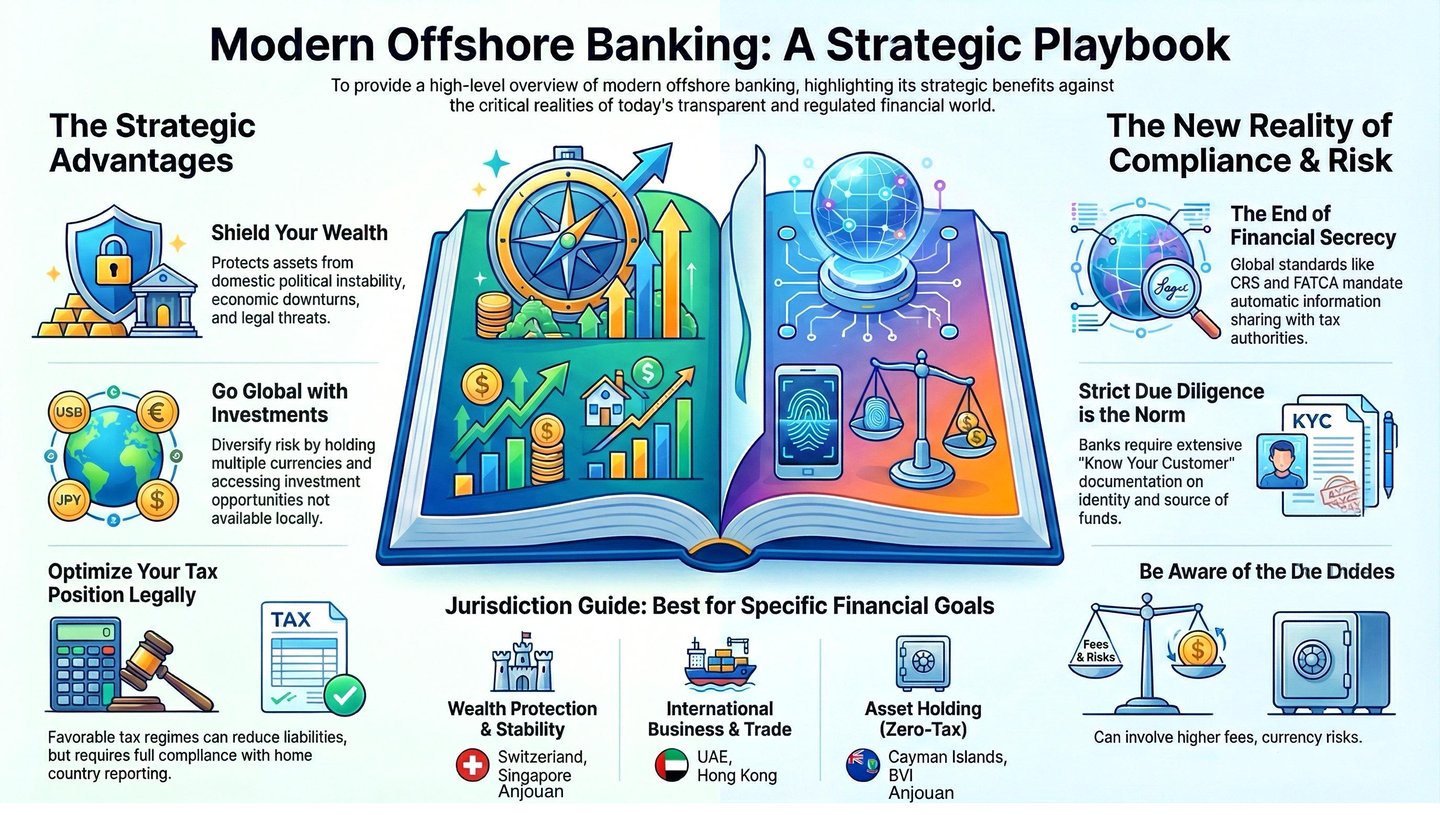
4. Jurisdictions: Where to Bank Offshore
A. Tier 1 – Private and Premier Banking
- Switzerland, Liechtenstein, Luxembourg, Monaco, Austria: Structured wealth management from €500,000+
- Singapore, UAE, Channel Islands, Anjouan (Comoros): High-quality banking with more flexible thresholds
B. Tier 2 – Mid-range Banking
- United States, Portugal, Latvia, Mauritius: Reputable banks offering international services at $100,000+ levels
C. Tier 3 – Accessible Entry Points
- Panama, Georgia, Belize: Starting from $25,000 or less
- Certain banks in the U.S. and Channel Islands: Conditional openings for non-residents with vetted profiles
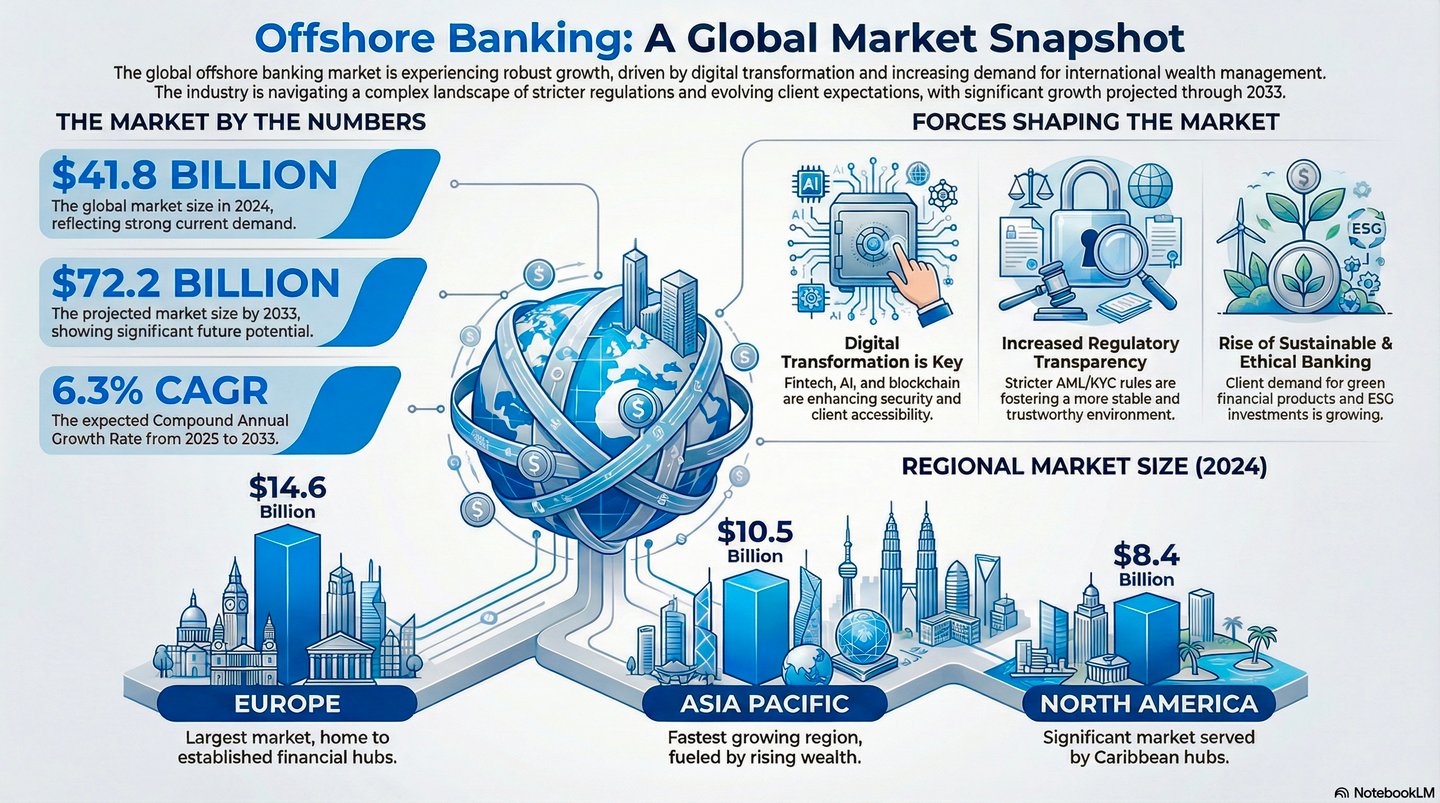
Offshore banking refers to banking activity conducted outside the client’s country of residence, typically in jurisdictions explicitly designed to attract foreign capital.
Core Characteristics
- Jurisdiction chosen for asset protection, succession planning, currency access and continuity of banking relationships
- Banks in such jurisdictions are frequently restricted from serving the local population and serve non-residents almost exclusively
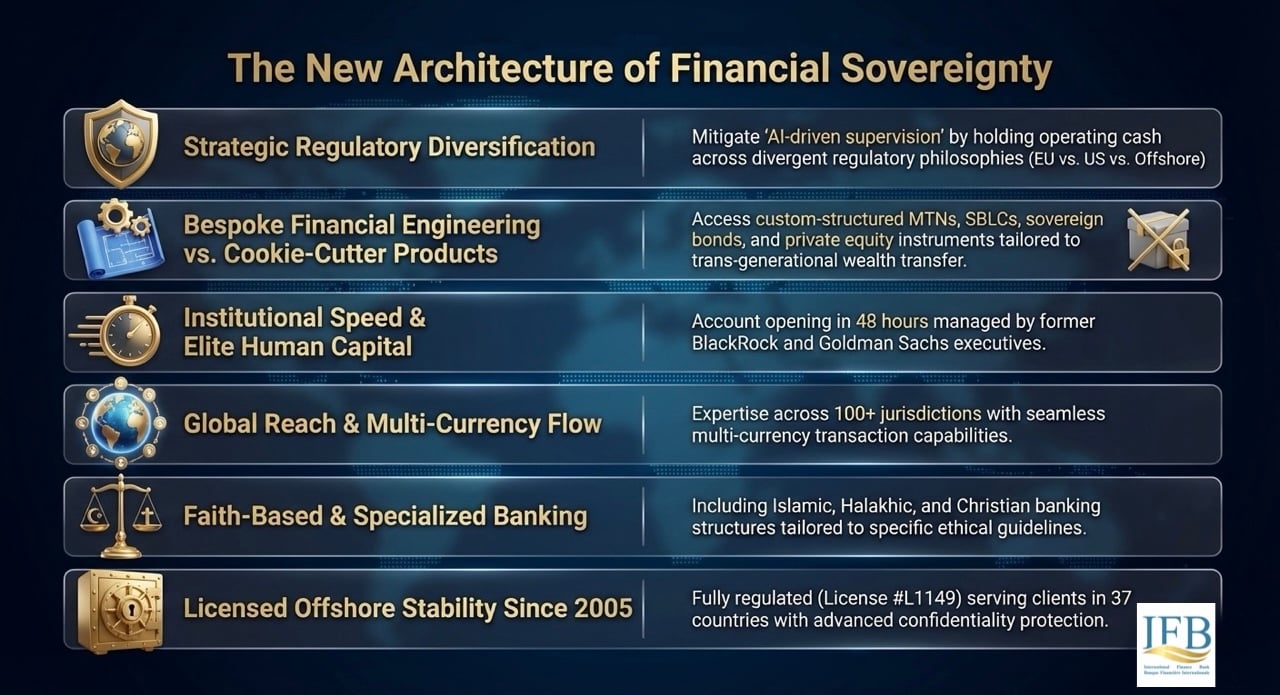
✓ Licensed Bank: Full Banking License A #L1149, regulated by Anjouan, Union of Comoros
✓ Global Reach: Serving clients in 37 countries since 2005
✓ Asset Protection: Secure offshore jurisdiction with advanced privacy protection
✓ Licensed Bank: Full Banking License A #L1149, regulated by Anjouan, Union of Comoros
✓ Global Reach: Serving clients in 37 countries since 2005
✓ Asset Protection: Secure offshore jurisdiction with advanced privacy protection
✓ Licensed Bank: Full Banking License A #L1149, regulated by Anjouan, Union of Comoros
✓ Global Reach: Serving clients in 37 countries since 2005
✓ Asset Protection: Secure offshore jurisdiction with advanced privacy protection
✓ Licensed Bank: Full Banking License A #L1149, regulated by Anjouan, Union of Comoros
✓ Global Reach: Serving clients in 37 countries since 2005
✓ Asset Protection: Secure offshore jurisdiction with advanced privacy protection
✓ Licensed Bank: Full Banking License A #L1149, regulated by Anjouan, Union of Comoros
✓ Global Reach: Serving clients in 37 countries since 2005
✓ Asset Protection: Secure offshore jurisdiction with advanced privacy protection
The Anjouan Distinction
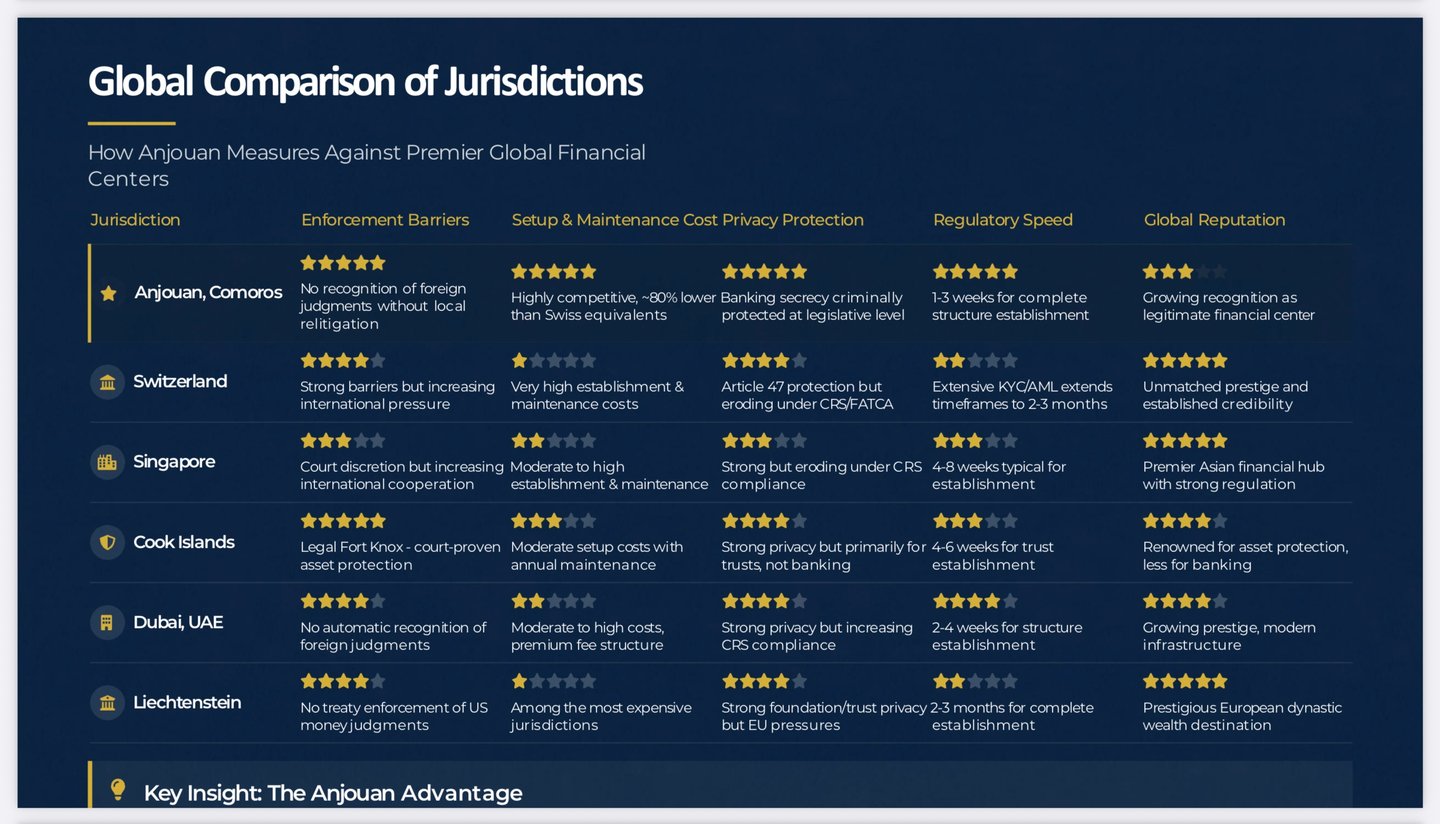
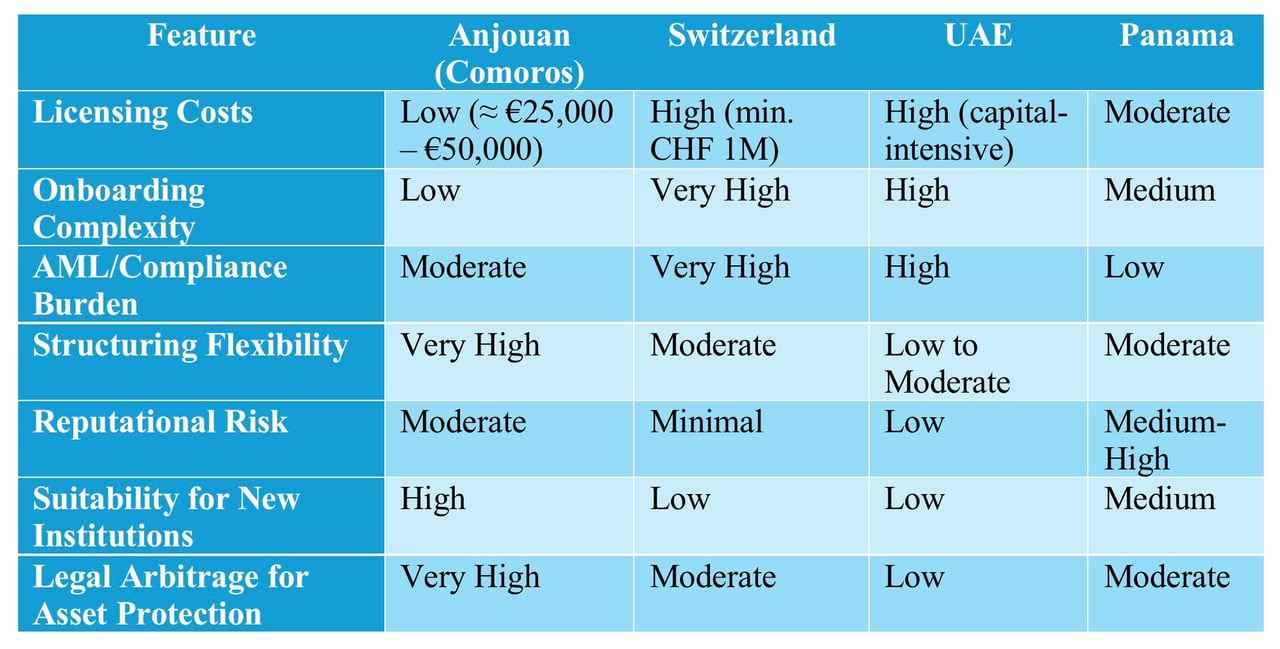
Unlike traditional hubs such as Switzerland or Singapore, Anjouan regulates its financial sector nationally rather than through a supranational framework, applying AML and CFT standards through its own authority. This gives clients the ability to:
- Open offshore accounts through locally regulated entities
- Incorporate and administer international business companies (IBCs) under flexible governance statutes
- Use Comorian financial instruments for structured private placements, interbank operations, or asset reallocation
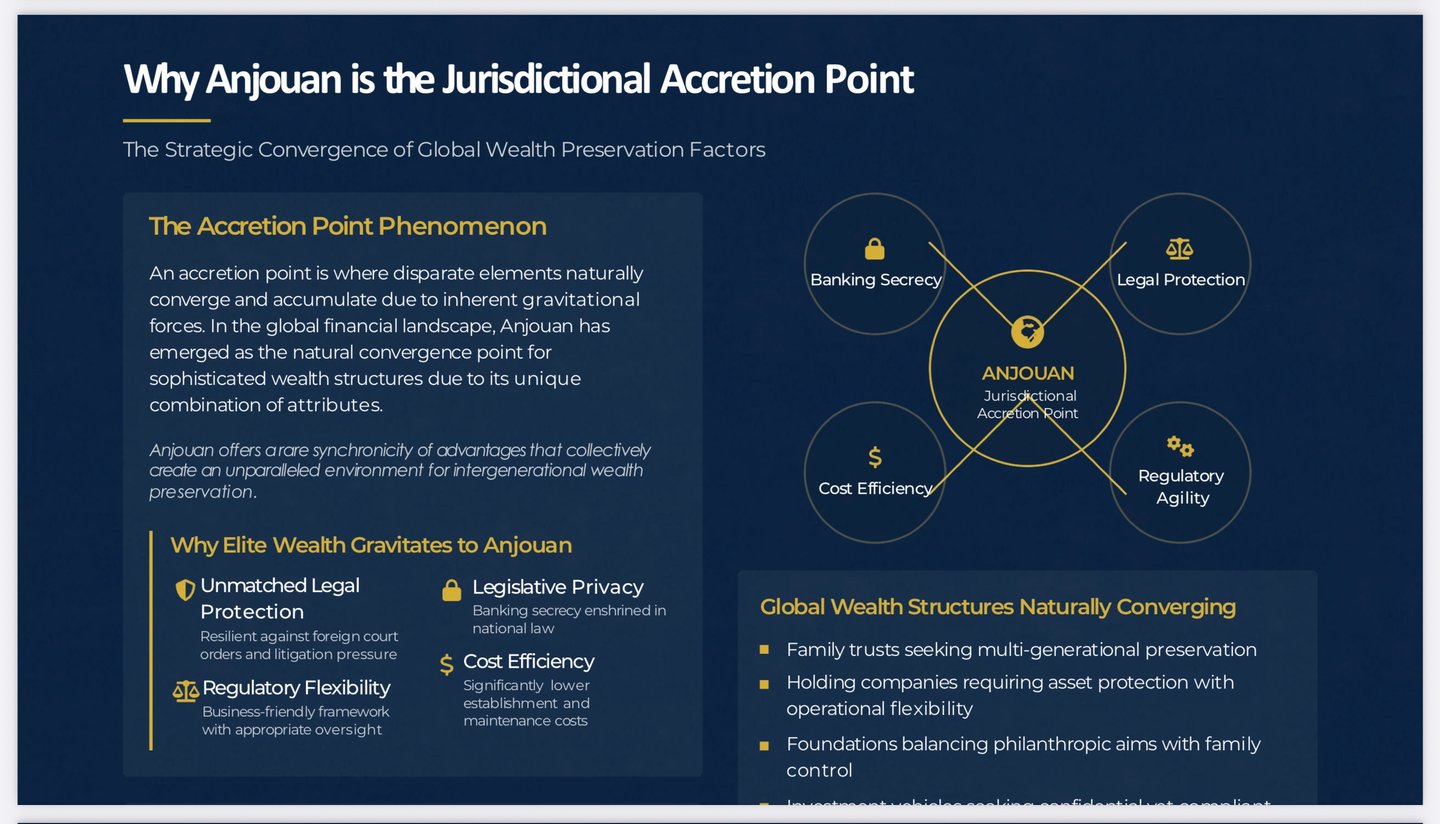
Jurisdictional Engineering: Anjouan as the Nexus
While other jurisdictions may provide greater institutional prestige, Anjouan offers jurisdictional control. In practice, this means:
- Regulatory Engineering – Create structures such as offshore trusts, and SPVs with tailored charters and asset walls.
- Transactional Sovereignty – Issue internal instruments (e.g. promissory notes, IBOEs, digital bearer certificates) with internal legal validity.
- Proportionate Supervision with Internationally Recognised Outputs - Access international transaction rails (e.g. SWIFT messaging via sponsor banks) from a legally licensed entity.
- Multi-layered Asset Protection – Combine Anjouan entities with custodial holdings in Tier 1 jurisdictions for dual advantage.
IFB Bank’s Offshore Banking Playbook – Optimised for Anjouan Structures
Step 1: Strategic Intent
- Asset Segregation: Clients may structure their personal and operating capital through separate Comorian IBCs.
- Risk Shielding: Use Comorian law to reduce litigation exposure and enhance transactional privacy.
- Licensed Institutions: Establish a licensed financial institution in Anjouan under the applicable regulatory framework, enabling client onboarding and transaction execution within the scope of the licence granted.
Step 2: Jurisdictional Architecture
- Anchor: Anjouan – base of legal operation and regulatory charter
- Execution Layer: UAE, Mauritius, or EU – correspondent relationship, investment booking, and custody
- Interface Layer: United States or Singapore – credit card issuance, payment gateways, FX services
Step 3: Onboarding and Compliance
- KYC/AML: Risk-based screening in accordance with applicable AML and CFT requirements; beneficial ownership declaration; legalised passport and proof of address
- Opening Deposits: Set individually according to account type, intended activity and risk profile.
- Licensure (if applicable): For those seeking institutional status (EMI, PI, bank), application requires a regulatory package, projected balance sheet, and procedural manuals
Use Case Scenarios for Comorian Offshore Banking
Asset Protection Structure for HNWIs
- Objective: Shield assets from expropriation or predatory litigation
- Strategy: Create a Comorian trust or IBC to hold movable and immovable property abroad
- Outcome: Asset protection within the limits of applicable Comorian law; discretionary control over trust distributions retained by the settlor’s chosen structure.


Comparing Anjouan to Traditional Offshore Centres
IFB Bank’s Role: Gateway to Strategic Offshore Control
IFB designs financial entities from the ground up—jurisdictionally optimised, legally compliant, and structurally sound. In the Comorian context, this includes:
- Provision of bespoke Anjouan IBCs, banks, EMIs, and SPVs
- Integration with international legal, fiduciary, and audit professionals
- Modular structuring for crypto, real estate, inheritance, or trade finance
Anjouan as a Tactical Pillar of Sovereign Finance
Anjouan, Comoros, when properly structured and integrated, serves not as a financial escape hatch but as a jurisdictional command post. It provides the legal scaffolding to assert control over one’s capital, transactions, and destiny—without sacrificing access to regulated financial infrastructure.
Through IFB Bank’s strategic partnerships and jurisdictional intelligence, clients gain the ability to construct resilient, private, and fully operational financial ecosystems, harmonising privacy, compliance, and access.
For institutional onboarding, individual structuring, please contact the Offshore Strategy Desk at: legal@infiba.com
Offshore banking is a structuring discipline, not a contingency. Whether the objective is to reduce concentration risk across legal systems, to secure continuity of banking access, or to build an international presence with proper foundations, IFB provides the institutional knowledge, the correspondent access and the discretion required to do it properly. Every structure is designed to withstand scrutiny, because a structure that cannot withstand scrutiny is not an asset but a liability.
For an initial eligibility screening or to receive your personalised onboarding roadmap, contact our Offshore Banking Division directly via contact.
Disclaimer:
All structures must comply with international standards for anti-money laundering (AML), counter-terrorism financing (CTF), FATCA/CRS, and local laws. IFB Bank facilitates compliant offshore frameworks and does not promote illicit financial activity.
Services described on this page are available only in jurisdictions in which IFB may lawfully provide them. IFB does not solicit banking business in any jurisdiction in which such solicitation or provision would require an authorisation or establishment not held by the Bank.